Load Newsreader Bold Font
A few weeks ago I typed a single sentence into an AI tool (well, maybe a couple of sentences) and asked it to build me a website.
Thirty (ish) seconds later I had a Homepage, an About page, and three sections of copy that described a business I do not run, for a customer who does not exist, in a tone that belonged to absolutely no one.
It looked okay. It was clean and centered and had a nice little gradient. But I do think that it was a very forgettable website, which is a strange thing to say about something a computer built in less time than it takes me to make coffee.
Here is a question: if a machine can spin up a website in thirty seconds, what exactly is the point of you? You, with your opinions and your weird font preferences and your three-hour debates about whether the button should say “Get Started” or “Let’s Go.”
The very honest and human answer is that the machine got me a draft, and you are what turns a draft into something a real person wants to hire. Let me walk you through why that gap exists, and why it is not closing anytime soon.
What AI Website Builders Are Genuinely Good At
Let me start by being fair to the robots, because pretending AI is useless will not help you (or me), and it makes you sound like someone who is scared rather than someone who is paying attention. There are a handful of things AI website builders do genuinely well, and it is worth being honest about all of them:
Getting Rid of The Blank Page
Hand a tool like ChatGPT or an AI site generator a clear prompt and it will give you a sensible page hierarchy, placeholder copy that follows proven patterns, and a layout that will not embarrass you.
For a designer staring down an empty canvas at the start of a client project, that is a real gift, because the hardest part of any build is often the nothing you are starting from, and AI hands you something to react to instead of something to invent.
Speed on The Boring Stuff
AI can draft alt text for forty images while you drink your lunch, which is the kind of chore that quietly eats an entire afternoon if you let it.
First-Draft Copy You Can Fix
It will rough out an FAQ section, suggest meta descriptions, and reword a paragraph you have rewritten so many times the words have stopped meaning anything. None of it ships as-is, but a rough draft is far easier to improve than a void.
Tasks That Drain You Without Defining You
This is the real category. The work that exhausts you but does not distinguish you is exactly what you should be handing off, and AI was built to absorb it.
What I’ve learned: Treating AI as my fastest intern, removes friction at the start of a project and handles the repetitive middle, which frees up my energy for the parts only I can do.
This matters because burnout in this work rarely comes from the creative decisions, it comes from the hundred small chores surrounding them, and AI is built to eat those chores for breakfast.
Why AI-Generated Websites All Start to Look the Same
AI is trained on what already exists, which means it is very good at producing the average of everything it has seen.
The average is safe and is also why so many AI-built sites have that uncanny sameness, the same hero section with the same confident headline over the same soft gradient, the same “trusted by” logos, the same three-column feature grid that fades in as you scroll.
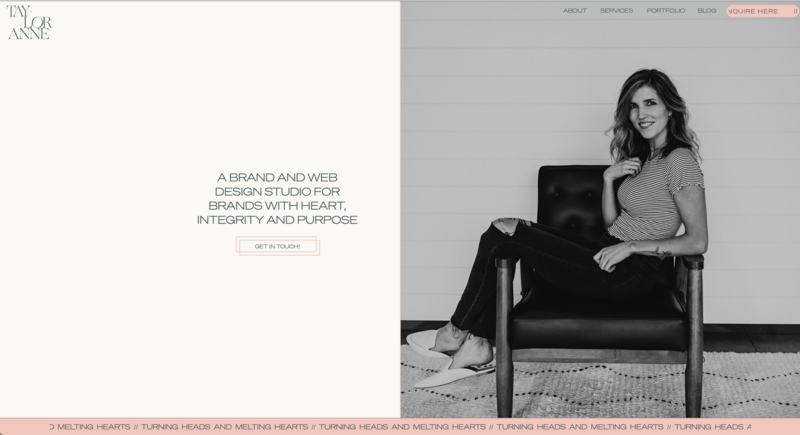
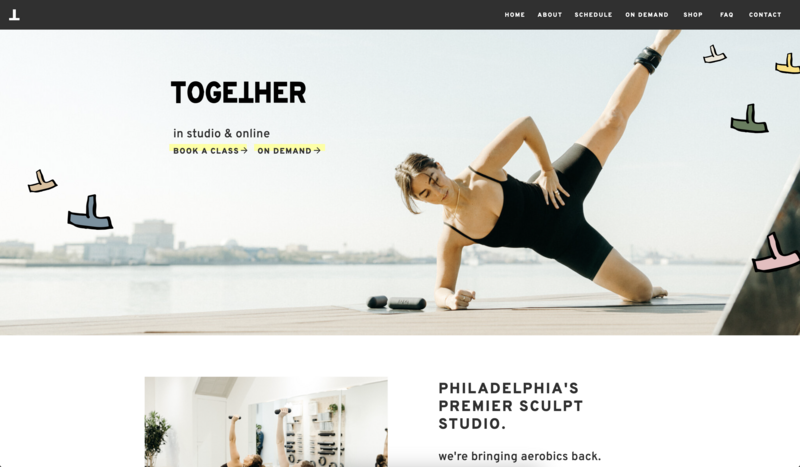
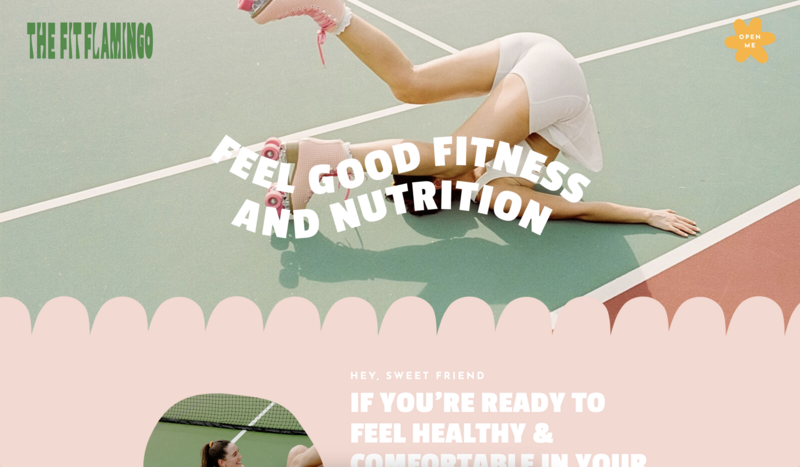
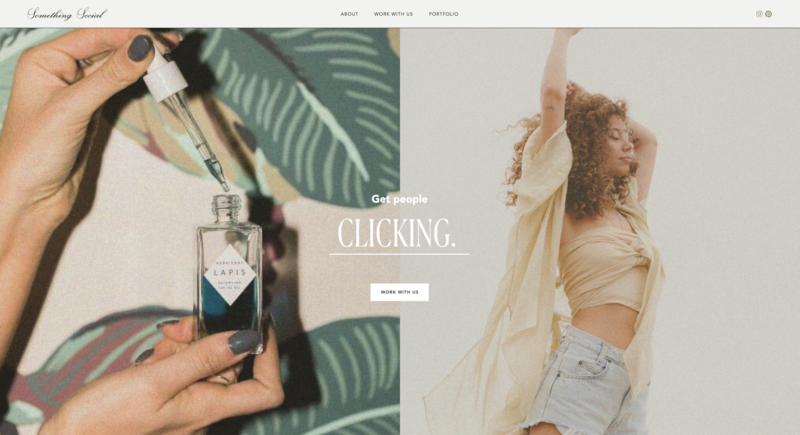
I started noticing this when a friend asked me to look at four different sites she was considering as inspiration. Three of them had clearly been generated or heavily templated, and I could have swapped their homepages and she would not have noticed for a solid minute. They were fine, but they were interchangeable, which for a business trying to win a customer is arguably worse than bad, because a bad site at least gets remembered.
Is an AI-Generated Website Bad for SEO and Discovery?
Not automatically, but it puts you at a disadvantage if you aren’t careful.
Search engines and the large language models people now use to find businesses both reward content that is specific, original, and clearly tied to a real entity. When your copy could describe any photographer, any coach, or any bakery in your city, you have given the algorithms nothing distinctive to grab onto, and you have given a potential customer no reason to choose you over the nine other tabs they have open.
The fix isn’t to abandon the tools. The fix is to refuse to ship the average. Take what the AI gives you and then do the thing it cannot, which is to make it unmistakably yours.
Why AI Websites All Feel Like Nobody Lives There
Here’s the thing nobody talks about when they’re marveling at how fast AI can spin up a website: fast and forgettable are not mutually exclusive.
The first thing worth understanding is that most AI website builders are not actually designing anything.
They’re assembling pre-built pieces, headers, hero sections, feature grids, footer layouts, based on your instructions. The output looks designed because the components were designed, by humans, in advance.
What the AI did was pick which ones to stack together. That’s a meaningful difference, and it’s why so many AI-generated sites feel like you’ve seen them somewhere before, because you have.
Beyond that, AI-generated content has a few other problems. Because AI predicts the next likely word based on everything it has already seen, it tends to produce the average of the internet, which sounds fine until you realize that “fine” is exactly the problem. Generic copy that could describe any business in your category gives search engines nothing distinctive to index and gives a potential customer no reason to choose you.
Search engines are also increasingly built to reward content that comes from a real person with real experience, what Google calls E-E-A-T, which stands for Experience, Expertise, Authoritativeness, and Trustworthiness. AI cannot draw from personal experience because it has none, and that gap shows up in rankings, especially in competitive or trust-sensitive categories.
And then there’s accuracy, AI generates confident-sounding sentences whether or not they are true, and a single factual error on your website does more damage to your credibility than a slow load time ever could.
None of this means AI is useless for websites. It means AI output needs a human behind it, one who can catch what’s wrong, add what’s missing, and make sure the finished product actually sounds like someone worth hiring.
What Only a Human Can Bring to a Website
So what is the human part, specifically? Because “add your personal touch” is the kind of advice that sounds nice and tells you nothing. Let me go straight to the point, because the difference between a human-designed site and an AI-generated one usually lives in a handful of decisions that a machine genuinely cannot make for you.
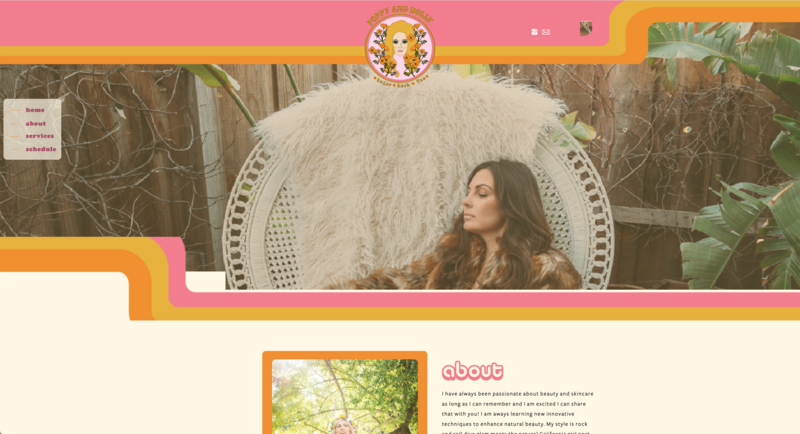
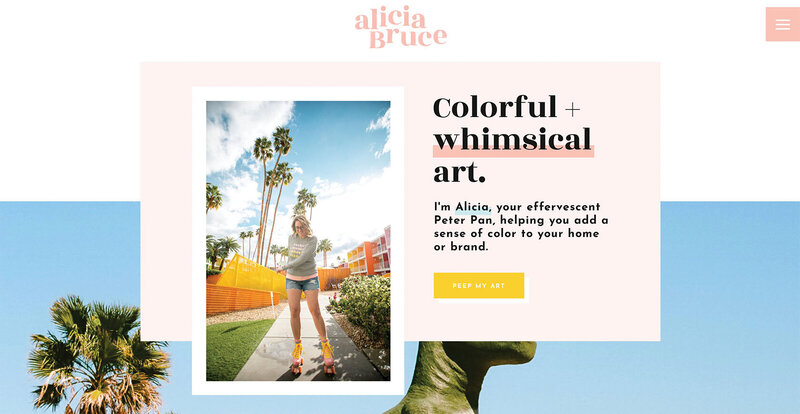
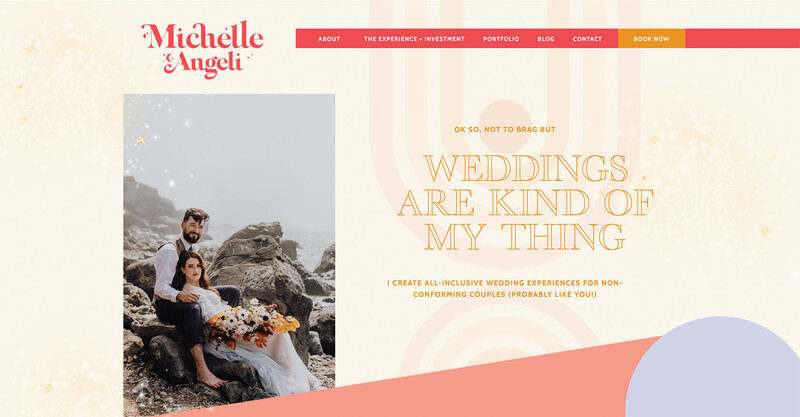
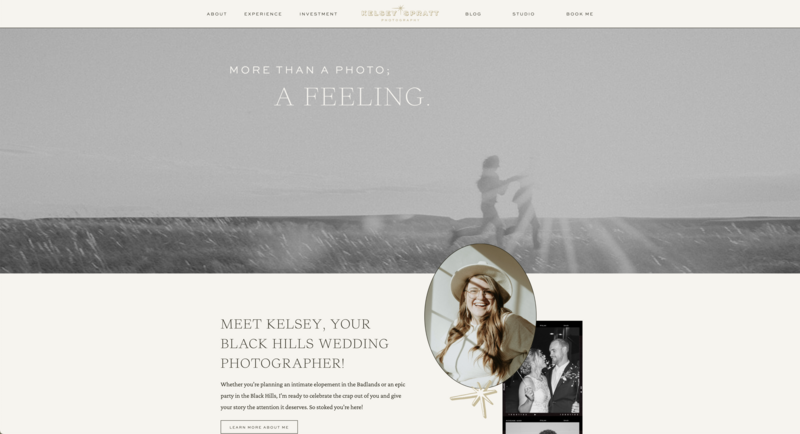
1. Taste and the Confidence to Break the Pattern
AI optimizes toward what works on average; a human designer knows when to leave a generous, almost uncomfortable amount of white space because the brand is luxury and restraint is the whole point.
A human knows when the “best practice” of a sticky navigation bar is actually cluttering a portfolio that should feel like walking through a quiet gallery. The machine will never feel that, because it has no gut, it has a probability distribution.
Try this: When you finish a draft, ask yourself one question the AI cannot answer for you, which is “does this feel like the person it is for?” Then change one thing that makes it feel more like them and less like everyone. One real change beats fifty safe ones.
2. Stories That Actually Happened
This is my favorite because our personal stories, experiences, perspectives, is something that no one can fabricate.
The single most powerful thing on most small business websites is a true story, and true stories are the one thing AI cannot manufacture without lying.
When a wedding photographer writes about the time the power went out at a reception and she shot the first dance by the light of forty phone flashlights, that is not content, that is trust. AI can imitate the shape of that story, but it cannot have lived it, and readers can feel the difference even when they cannot name it.
Your lived experience is your unfair advantage. The mistake you made and learned from, the client who changed how you work, the reason you started this business at all, these are the details that make a stranger decide you are a person worth paying. Feed those into your site on purpose, because no tool on earth can generate your actual life.
3. Knowing Your One Real Customer
AI writes for the imaginary everyone. You are writing for one specific person, the customer you actually want more of, and you know things about her that no model could infer. You know she is comparing you to a cheaper option and quietly worried she will regret going cheap. You know she does not care about your awards, she cares about whether you will text her back.
A human can write a website that speaks to that exact worry, in the words that customer would actually use, and that kind of precision is what turns a visitor into an inquiry.
Examples of Websites Real People Built on Showit
I quickly want to highlight a few recent website launches that resulted from peoples vision and creativity.
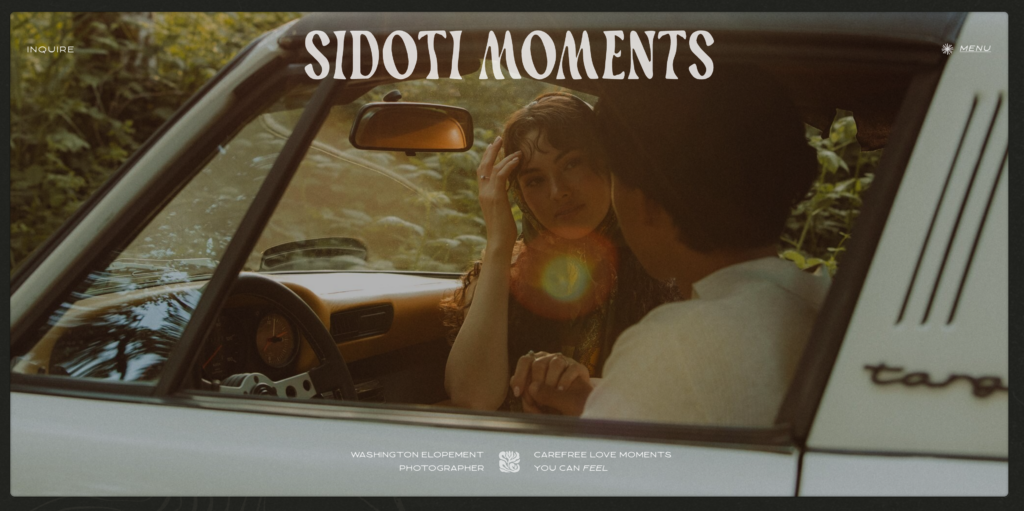
1. sidotimoments.com
Industry: Wedding and Event Photography
Notice that the full-bleed hero isn’t a posed couple in a field – it’s an intimate, film-toned moment shot through a car window. The vintage serif wordmark sits centered at the top with nothing competing for attention, and the only copy on the entire page is “carefree love moments you can feel.” No AI would have made that editorial call. It feels like a magazine, not a website.
Check out the full site here.
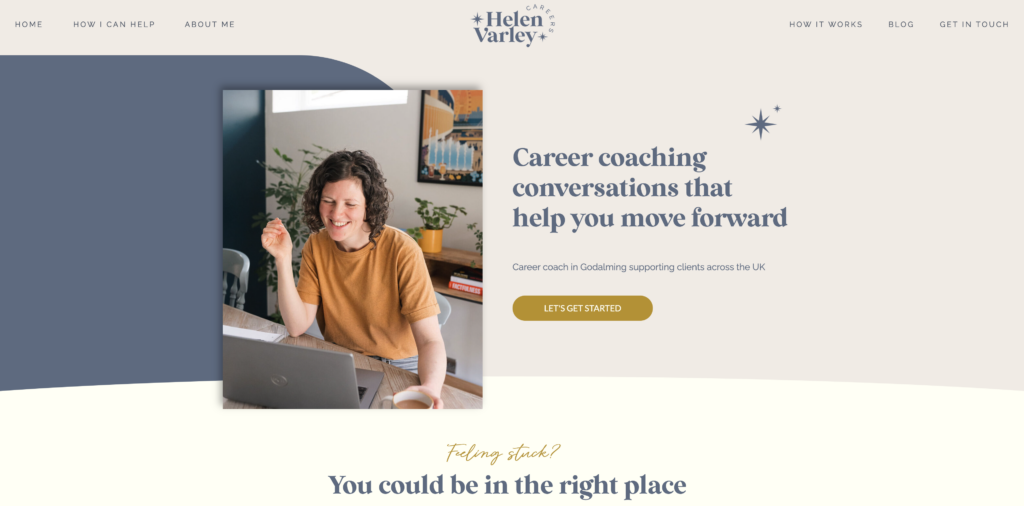
2. hvcareers.co.uk
Industry: Career Coaching
What I love about this one is that the dusty blue geometric shape behind the photo isn’t a stock layout choice, it’s a deliberate design decision that creates depth without clutter. The gold script “Feeling stuck?” paired against the bold serif headline below it is the kind of typographic detail that takes real taste to pull off. An AI would have given you a stock headshot on a white background and a button that says “Book a Call.” This feels like it was built for one specific person, because it was.
Check out the full site here.
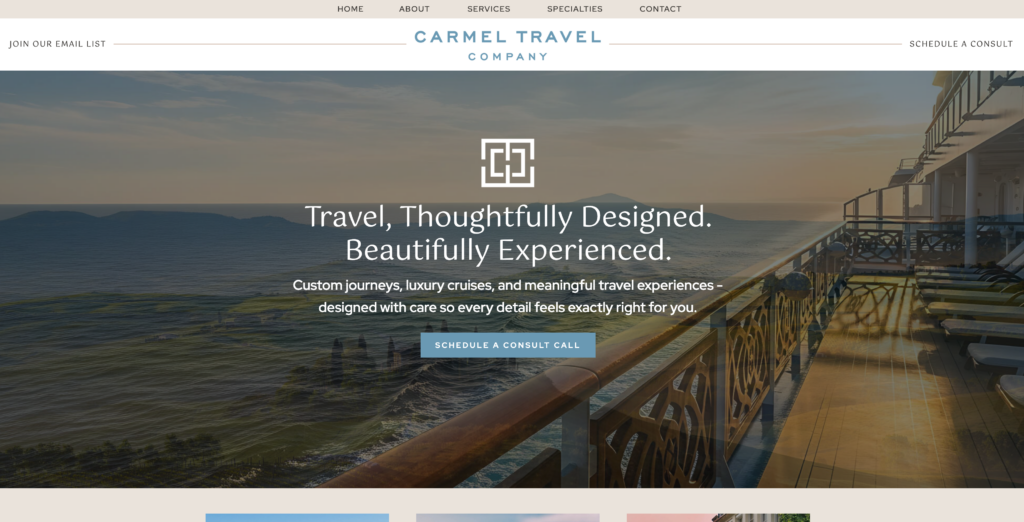
3. carmeltravelcompany.com
Industry: Travel Agency
What I love about this one is how much restraint it takes to let a photo like that breathe. The double-nav layout, utility links at the top, brand centered below, is a deliberate structural choice that signals luxury before you read a single word. The couple tiny in the distance at the bottom of the hero is the kind of detail a human puts there on purpose, because it makes you feel something. An AI would have centered a stock beach photo and called it done. This feels like an invitation.
Check out the full site here.
How to Use AI Without Losing Your Voice
This is the part that matters most, because most people are not choosing between fully human and fully robot, they are figuring out how to blend the two without ending up with something soulless. Here is the workflow I have landed on after a lot of trial and a fair amount of error.
- Start with AI for the scaffolding, the structure and the first ugly draft, because a rough draft is far easier to fix than a blank page.
- Then put the draft through what I think of as the humanity pass, where you read every line out loud and cut anything you would never say to a customer sitting across from you. If a sentence sounds like it came from a brand guidelines PDF, it goes. If it sounds like you on a good day, it stays.
- After that, do the additions only you can make, like a real story, the specific detail, the slightly weird opinion that makes you you. The goal is not to hide that you used AI, the goal is to make sure the finished thing could only have come from you. This matters because a website is a promise about what working with you will feel like, and a promise written entirely by a machine is a promise you cannot keep.
One small warning from someone who learned it the hard way: AI will quietly flatten your voice if you let it. It loves a tidy little three-part list and a tone that is agreeable to the point of being beige. Your job is to push back on that pull every single time, to keep the rhythm of how you actually talk, because your voice is not a flaw to be smoothed out, it is the entire reason someone would pick you.
What No Prompt Can Replace
Strip everything else away and it comes down to this: a website is not a document, it is a relationship that starts before you have met.
AI can build the room, but you are the one who decides what it feels like to walk in, whether it feels warm or clinical, whether a visitor feels seen or processed. That feeling is not a feature you can prompt your way into. It comes from a person who cares, making a thousand small choices on behalf of another person they want to reach.
The future is not human versus AI, it never was. It is humans who know how to use AI versus humans who refuse to, and the ones who win will be the people who let the machine handle the busywork while they pour their energy into the parts that carry their fingerprints. The robots got faster and made the human part more valuable, not less.
Speaking of pouring yourself into your work without fighting your tools to do it, this is exactly where the right platform matters.
Showit gives you complete drag-and-drop design freedom, which means the taste and the stories and the weird-on-purpose choices that make your site yours can actually make it onto the page, instead of getting flattened into whatever a rigid template allows.
You can pull in AI to speed up the rough draft, then use Showit to make the finished site look and feel unmistakably human, because nothing about it is locked behind code or someone else’s idea of “best practice.”
Ready to build a website that could only have come from you?
Try Showit free for 14 days and see why thousands of designers and business owners trust it to bring their actual vision to life.

Sarah has been part of the Showit team for nearly four years, where she works as a copywriter crafting content that educates, encourages, and celebrates the creative entrepreneurs who make up the Showit community. When she's not writing, you'll find her with a book in hand (usually something about leadership or personal growth), cheering on Arizona sports teams, or connecting with people over a really good cup of coffee because, let's be honest, there's always a cup nearby. Sarah believes in the power of stories, the importance of showing up authentically, and that every entrepreneur deserves to be celebrated for the brave work they're doing.