Load Newsreader Bold Font
There’s a version of your workday where you spend most of it doing the thing you love, designing, writing, shooting, strategizing, building.
And then there’s the version most of us are living, where creative work happens in the margins between answering emails, wrestling with SEO checklists, writing captions we immediately overthink, and staring at a blank “About Me” page like it owes us money.
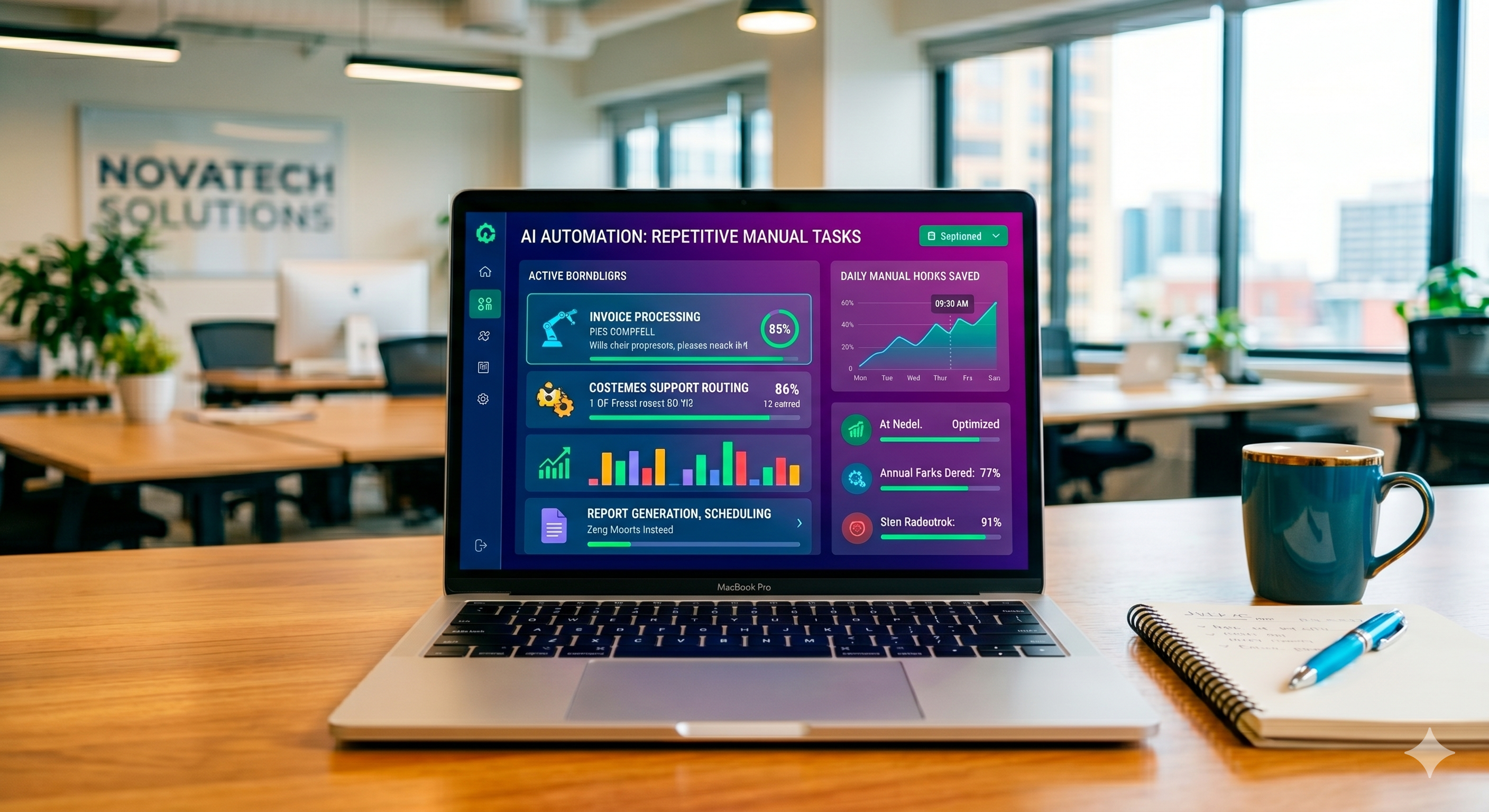
I believe AI isn’t going to replace creative people, but it is going to expose which creative people are still spending half their day on tasks a tool could do in 30 seconds. You don’t have to be one of them.
These are the seven things worth handing off to AI so you can get back to the part of your business that needs you.
1. First Drafts of Anything You Dread Writing
For most creatives, the blank page is the most difficult part to navigate. Whether it’s a client proposal, a blog intro, a bio you’ve been avoiding for six months, or an email to a client who wants one more revision (sigh), the hardest part is just starting. And that’s exactly where AI comes in.
AI is genuinely excellent at generating a solid first draft fast, and the more you use it as a tool, the more useful it is. It won’t be perfect or sound exactly like you (nothing will ever sound exactly like you), but it gives you something to react to, edit, and shape into something good rather than staring into the void. Use it like a really fast assistant who doesn’t complain about your feedback: let it draft, you decide.
Try this: Next time you’re procrastinating on a piece of writing, open your AI tool of choice, paste in your main points or goal, and ask for a rough draft. Set a timer for 10 minutes and just edit what comes back. You’ll often finish something in 20 minutes that would have taken you two hours of staring.
2. Keyword Research and SEO Groundwork
Let me paint you a picture. You have a great blog post idea, you write it, you publish it, and it gets 11 views, four of which are probably you.
SEO is not glamorous, and for a lot of creatives, it feels like learning a second language that changes its grammar every six months. But it matters, and the research part, finding the right keywords, checking search volume, understanding what people are Googling, is tedious enough to be a perfect AI task.
AI tools can help you identify keyword clusters around your topic, suggest variations you hadn’t thought of, and help you understand search intent. You still need a human brain to write something worth reading, but you don’t need one to figure out whether “brand photographer” or “personal brand photography” has more search traffic.
Why this matters for Showit users specifically: Whether you’re a designer building client sites or a business owner managing your own, your website is only as effective as its ability to be found. Leaning on AI for the research leg of SEO means you spend your time writing great content, not spiraling into keyword rabbit holes.
3. Repurposing Content Across Platforms
Maybe you wrote a great blog post, or recorded a solid podcast episode, or filmed a reel that performed well, and then it just… sits there, doing one job when it could be doing seven.
Repurposing content is one of the highest-ROI activities in content marketing, and it’s also one of the most tedious. Taking a 1500-word blog post and turning it into three LinkedIn captions, five Instagram hooks, and an email teaser requires time, not creativity. That’s a perfect job for AI.
Give it your original content and ask it to extract key points for a LinkedIn post, write a short teaser for your email list, or generate five different hooks for a social caption. You’ll still edit it to sound like you, but the structural work, the pulling apart and rebuilding, is something AI handles well.
The real win here: Your best ideas get more mileage without more effort. That’s just good math.
4. Client-Facing Templates and Boilerplate Emails
Every web designer I know has sent some version of the same email approximately 400 times. The “here’s what to expect from our process” email. The “this is what happens if you need revisions beyond scope” email. The “please send me your logo files in the correct format, not as a screenshot from Facebook” email.
(That last one really deserves its own template. Multiple copies.)
AI can help you build out a library of client communication templates that sound professional, warm, and clear. You give it the situation, the context, the tone you want, and it gives you a starting point. Then you save it, tweak it when needed, and stop rewriting the same thing from scratch every time a new client asks the same question.
This isn’t about being robotic in your client relationships. It’s about protecting your creative energy for the parts of those relationships that need it.
5. Social Media Captions (At Least the Starting Point)
Confession: I have spent 40 minutes writing a single Instagram caption. I have also spent 40 minutes writing a 600-word piece that I was genuinely proud of. Only one of those felt like a good use of 40 minutes.
Social media captions are important, and they absolutely need your voice and your perspective. But the drafting process doesn’t have to start from zero every time.
Use AI to generate three to five caption options for a given post. You’ll probably hate most of them. That’s fine. But one might have a hook that sparks something, or you’ll frankenstein two together and end up with something that sounds like you. Either way, you started with raw material instead of a blank box and a blinking cursor.
The key: Give AI good inputs. Instead of “write me a caption about my new service,” try “write me a caption for a web designer announcing a new VIP day offer, audience is small business owners, tone is warm and confident, and include a question at the end to drive engagement.” Better input, better output.
6. Analytics Summaries and Data Interpretation
Most creative people did not get into this industry because they love spreadsheets. And yet, understanding your website traffic, your email open rates, your social engagement, it all matters if you want to grow. The problem isn’t the data itself, it’s translating rows of numbers into something you can act on.
AI tools, especially when you can paste in data or connect them to your analytics platforms, are increasingly good at pattern recognition and plain-language summaries. Instead of staring at a dashboard trying to figure out why your traffic spiked in March, you can ask AI to tell you what it sees and what might be worth testing.
You still have to know your business well enough to apply those insights. But you don’t have to spend an hour just getting the data into a readable format first.
7. Brainstorming When You’re Running on Empty
Creative block is real. It happens to everyone, even the people who make it look effortless on Instagram (especially those people, honestly).
When you’re staring at a mood board that isn’t clicking, a content calendar that needs filling, or a client brief that isn’t inspiring you yet, AI is a genuinely useful brainstorm partner. Not because it has better ideas than you, but because it can throw out 20 directions fast and sometimes one of them is the spark you needed. Try asking it for 10 different angles on a topic, or have it describe your client’s dream customer in detail, or rewrite your brand statement five different ways. Most of what comes back won’t be right, but the process of reacting to options and deciding what you do and don’t want often gets you unstuck faster than staring at a blank document waiting for inspiration to show up.
Think of AI brainstorming the way you’d think of a good conversation with a creative friend. They don’t always give you the answer. Sometimes they just ask the right question, or say something slightly wrong that points you toward what’s right.
The Work That Still Needs You
Here’s what AI cannot replicate: your specific point of view. The thing you bring because of your experiences, your taste, your relationships, your particular way of seeing the world. AI can draft a proposal, but it cannot build the trust that makes a client want to hire you in the first place. It can suggest keywords, but it cannot write something that makes a reader feel genuinely understood and keeps them coming back for more.
The creatives who will thrive in the next decade aren’t the ones who refuse to use AI, and they’re not the ones who outsource everything to it either. They’re the ones who use it strategically to protect their most valuable resource: time and creative energy. Give AI the tasks that drain you, and save your energy for the ones that define you.
Speaking of protecting your creative energy, your website platform shouldn’t be a source of stress. Showit is built so that designers and small business owners can enjoy the process of creating a beautiful, functional site without needing a developer or fighting rigid templates.
If you’re spending too much time wrestling with your website when you should be doing the work you love, it might be time to try something different. Try Showit free for 14 days and see what it feels like when your platform gets out of your way.

Sarah has been part of the Showit team for nearly four years, where she works as a copywriter crafting content that educates, encourages, and celebrates the creative entrepreneurs who make up the Showit community. When she's not writing, you'll find her with a book in hand (usually something about leadership or personal growth), cheering on Arizona sports teams, or connecting with people over a really good cup of coffee because, let's be honest, there's always a cup nearby. Sarah believes in the power of stories, the importance of showing up authentically, and that every entrepreneur deserves to be celebrated for the brave work they're doing.