Load Newsreader Bold Font
Have you ever looked at your bank account at the end of a busy month and wondered, “If I’m working this hard, why doesn’t it feel like my business is growing?”
I’ve talked to small business owners (florists, consultants, bakers, web designers and photographers) who feel like they’re on a hamster wheel. They’re “doing marketing,” but it feels more like throwing spaghetti at a wall (have you ever done that? It’s actually fun… but messy and purposeless). One day it’s a random Instagram post, the next it’s a flyer at the local coffee shop, and the week after it’s an email sent at the last minute.
When business owners hear the word “marketing funnel,” they often think of complex tech, expensive ads, or something that only “big” companies do. But if you’ve ever found yourself asking:
- “How do I get more people to actually find me?”
- “Why are people visiting my site but never reaching out?”
- “How do I get customers to come back a second time?”
…then you’re actually asking for a funnel. A funnel is just a fancy word for a reliable system that answers those questions.
In this blog, we’re going to look at how to build a funnel that works for your specific business, whether you’re a local service provider or an online shop, using the same intentional logic that experts use to turn simple content into a multi-million dollar engine.
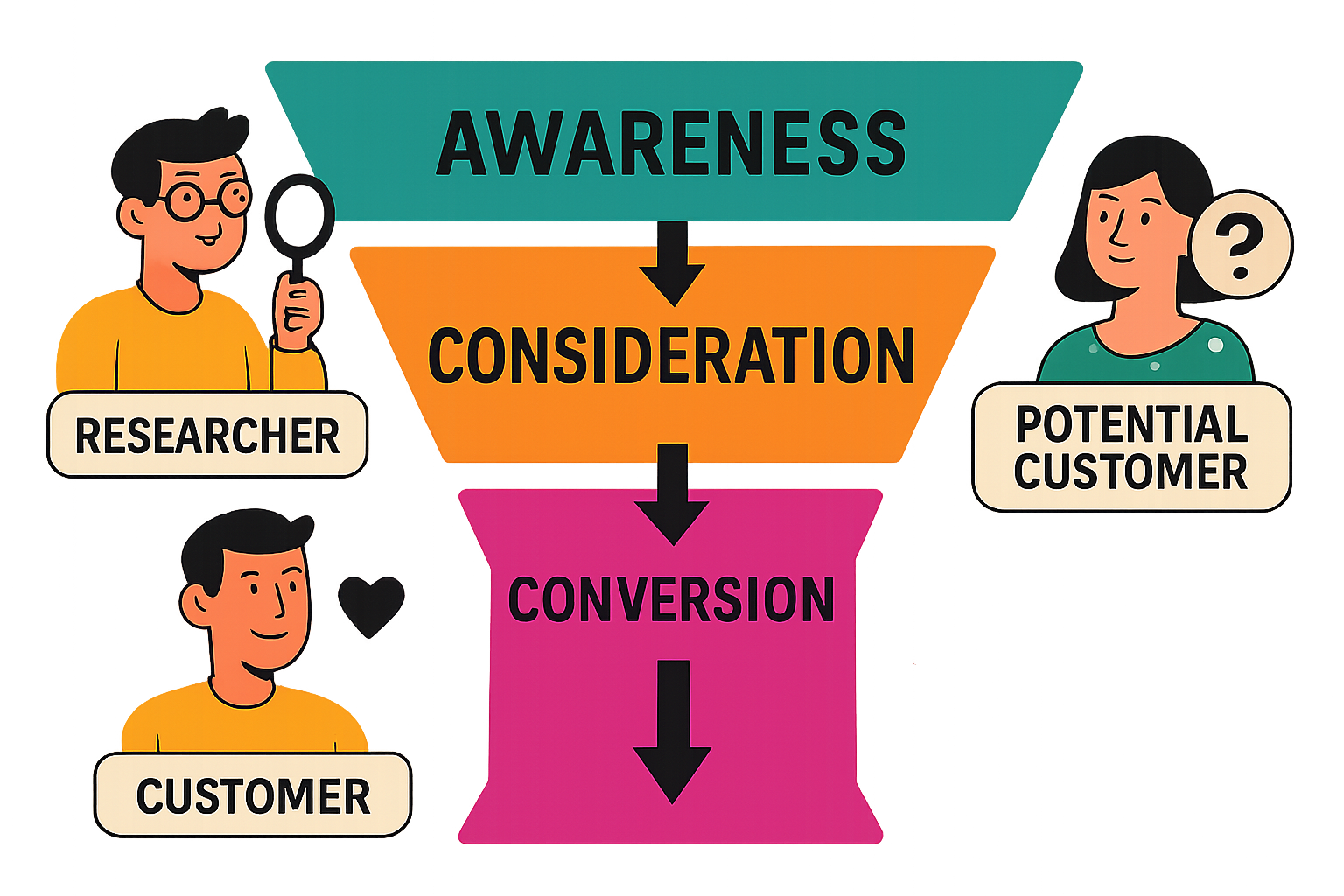
What Is a Marketing Funnel? (And Why It's Not as Complicated as You Think)
According to HubSpot's marketing funnel glossary, a marketing funnel represents the customer journey from brand awareness to purchase decision.
Think of it like a trail of breadcrumbs. You aren't forcing anyone to move; you're just making the path so clear and helpful that they want to take the next step.
- Top of Funnel (TOFU): They realize they have a problem or a need.
- Middle of Funnel (MOFU): They are looking at options (including you).
- Bottom of Funnel (BOFU): They are ready to commit and buy.
A marketing funnel is simply the path someone takes from discovering your business to becoming a paying customer. For a wedding photographer, that might look like: Instagram post → blog about wedding timeline tips → free shot list download → email nurture sequence → booking inquiry.”
Why Most Small Businesses Struggle With Marketing (And How Funnels Fix It)
Most small businesses struggle because their visibility is disconnected from their sales process. They are getting “seen,” but they aren't being “led.” This is where the magic of a funnel comes in.
If you haven’t followed his journey yet, Chris Donnely is a powerhouse entrepreneur who built one of the world’s leading digital agencies (Verb) before pivoting to help other founders scale. What makes him so special for us to watch is that he doesn't rely on “luck” or massive ad spends. He built a massive global audience simply by being the most helpful person in the room. He treats every single LinkedIn post, every video, and every newsletter not as a vanity project, but as a “front door” to his business.
Chris understands a truth that we sometimes forget in the hustle of daily operations: Attention is the first step, but it’s a wasted resource if you don’t give it a place to go.
Think of it this way: A great funnel isn't about crafting the perfect sales pitch or finding a “trick” to get people to buy. It’s about building a bridge of trust. When you stop trying to sell and start trying to solve, everything changes. By answering your customers’ deepest questions and calming their fears before they even have to ask, you stop being a “choice” among many. Instead, you become the only logical partner for them to hire. Your funnel is simply the path that lets them realize that at their own pace.
Without a funnel, you're like a store that gets foot traffic but has no checkout counter.
The 3 Stages of a Marketing Funnel (Your Customer's Journey)
Stage 1 – Awareness (Top of Funnel): They discover you exist
Stage 2 – Consideration (Middle of Funnel): They evaluate if you're right for them
Stage 3 – Decision (Bottom of Funnel): They're ready to buy
Stage 1- Getting Found: How to Build Your “Discovery Engine
This is the Top of the Funnel (TOFU). Whether you’re a local coffee shop,, a virtual assistant, or a web designer, you need a “Discovery Engine.”
The foundation here is simple: Content as an Asset.
Don't just post for the sake of posting.
Treat your content like a “front door.”
You want to provide high-volume, high-value information that solves problems for free. You aren't asking for anything yet; you’re just proving you’re the expert.
Small Business Questions to Ask Yourself:
- What is the #1 question my customers ask me before they hire me? (Make a video or blog post answering it!)
- Where does my ideal customer go when they are frustrated? (Is it Google? Instagram? A local Facebook group?)
Practical Tactics:
Think of these Practical Tactics as the “how-to” tools that turn a theoretical plan into real-world results. They are the specific actions you take to ensure your audience doesn't just see your business, but feels guided and supported at every single step of their journey toward hiring you.
- The Educational Post: If you're an interior designer, share “3 Colors That Make a Small Room Look Huge.”
- The Local Authority: If you're a local shop, partner with another local business for a giveaway (I know, there’s a bit of work to do, but this is very intentional work, so send that email or DM to other local businesses. You just never know who will respond!)
- SEO: Write blog posts on your Showit site that answer specific “How-to” questions your clients are searching for.
How to know it's working: Think of this like “The Guest List.” You’ve thrown a great party (your content), but now you want to know how many people actually want to stay in touch. We track this by looking at your Sign-up Percentage.
If 100 people walked into your shop and 10 of them joined your loyalty club, your “score” is 10%. If that number is high, it means your “freebie” is a hit! If it's low, it just means you might need a more exciting “gift” to offer them at the door. You're basically tracking how many people are saying, “I like your vibe—keep talking!”
They’ve seen your post. They’ve visited your site. But they haven't reached out. This is the Middle of the Funnel (MOFU).
One complete example: “Sarah, a Showit web designer, wrote a blog post answering ‘How much should a website cost?' It ranked on Google, got 500 visits in 3 months, and 50 people downloaded her pricing guide.
The Critical Middle Step: Moving From “Rented” to “Owned” Audience
There's this illustration that gets tossed around in the marketing world. I believe It's one of the most important concepts you need to understand as an entrepreneur trying to figure out how marketing is possible, helpful and not as difficult as big companies make it look:
Social media is a “rented house.”
Think about it like this: You're pouring hours into creating beautiful Instagram content, showing up consistently on TikTok, nurturing your Facebook community. But the reality is that it doesn’t matter how much you engage; you don't own any of those platforms. You're essentially building your entire business on someone else's property, and the landlord (the algorithm) can change the rules whenever they want (and we’ve seen it happen at least 15 million times this past year!)
One day your Reels are reaching 10,000 people. The next week? Maybe 300. The platform decides to prioritize a different content format, and suddenly your hard work isn't getting seen. Or worse, your account gets flagged, restricted, or hacked, and years of audience-building can vanish overnight.
This isn't meant to scare you. It's meant to wake you up to a reality that too many creative entrepreneurs ignore until it's too late.
The Bridge From Visibility to Ownership
This is where your marketing funnel comes in, and specifically, why a Lead Magnet is such a critical piece of the puzzle.
A successful funnel doesn't just stop at social media visibility. It “connects the dots” from that initial awareness all the way to a measurable outcome, and the first crucial step in that journey is moving someone from a rented platform to owned real estate: your email list.
Here's what that funnel progression looks like:
Social Media (Awareness) → Lead Magnet (Interest) → Email List (Owned Relationship) → Nurture Sequence (Trust) → Product/Service (Conversion)
Without that middle step, the Lead Magnet that captures email addresses, you're stuck in an endless cycle of “creating content” without ever truly building a business asset.
What Makes a Lead Magnet Worth Downloading
With so much more online marketing, people guard their email addresses. Their inbox is sacred space, and they're not going to hand it over for something mediocre. Your Lead Magnet needs to be valuable enough that someone thinks, “Yes, this is worth giving my email for.”
Lead Magnet Ideas for Creative Businesses
The best Lead Magnets solve a specific, immediate problem for your ideal client. They're not “everything you need to know about photography”, they're focused, actionable, and deliver a quick win.
For photographers, this might look like:
- A pricing calculator template
- “10 Email Templates for Responding to Wedding Inquiries”
- A location scouting checklist for engagement sessions
- A client preparation guide they can send before sessions
For designers, consider:
- A brand questionnaire template
- “The 5-Page Website Every [industry] Business Needs”
- A design revision workflow that protects your time
- A mood board creation guide
For other creative entrepreneurs:
- A social media caption template bundle
- A client onboarding sequence flowchart
- A launch timeline checklist
- An ROI calculator for [specific investment]
Notice what all of these have in common? They're specific. They solve one problem. And they provide immediate value before someone ever becomes a paying client.
Why This Move from Rented to Owned Changes Everything
When someone joins your email list, something fundamental shifts. They've raised their hand and said, “I want to hear from you.” That's permission you simply don't have on social media, where you're fighting for attention in an endless scroll.
Here's what you gain when you own your list:
Direct access: You land in their inbox. No algorithm decides whether they see your message.
Deeper relationships: Email allows for longer-form content, personal stories, and nuanced conversations that social media's character limits can't accommodate.
Higher conversion rates: Email is widely reported as one of the highest-ROI marketing channels according to Litmus. People who've opted into your list are exponentially more likely to invest in your services.
Platform independence: If Instagram shut down tomorrow, your email list would still be there. You own those relationships.
Data and insights: You can track open rates, click-through rates, and engagement in ways social media keeps increasingly opaque.
Think about your own behavior. How many brands do you follow on Instagram that you'd honestly miss if they disappeared? Now think about the email newsletters you actually open and read. That's the difference between rented visibility and owned relationship.
Making This Work in Your Business
If you're reading this thinking, “Okay, I get it, but I haven't set this up yet,” here's your practical next step:
Start with one simple Lead Magnet. Not five. Not a massive course. One valuable resource that your ideal client would genuinely want.
Then, create a landing page (your Showit website makes this easy) where people can sign up. Add that link to your Instagram bio, mention it in your captions, talk about it in Stories, include it in your email signature.
The goal isn't perfection. The goal is to start building that owned audience—one subscriber at a time.
And here's what I want you to remember: Every person who joins your email list is choosing you. In a world of endless noise and competition, that decision matters. Honor it by showing up consistently, providing value, and building a relationship that goes beyond a double-tap.
Because at the end of the day, your email list isn't just a marketing asset. It's a community of people who've said, “Yes, I want to be part of what you're building.”
And unlike rented land, that's something no algorithm can take away.
Small Business Questions to Ask Yourself:
- What can I give away for free that proves I am an expert?
- How can I keep the conversation going once they leave my website?
Practical Tactics:
- The “Cheat Sheet”: A PDF checklist (e.g., “The Ultimate Wedding Day Timeline”).
- The Newsletter: A weekly tip that makes their life easier.
- The Quiz: “Which Skin Care Routine is Right for You?”
Stage 2 – Building Trust: How to Nurture Your Email List
Once someone joins your list, you're not done. In fact, you're just beginning. This is where most businesses drop the ball—they capture emails but never build the relationship.
Your email sequence should:
- Welcome them and deliver the promised lead magnet immediately
- Share valuable content weekly (not just promotions)
- Tell stories that build connection
- Address their biggest fears and objections
- Make small asks before big asks
Example: A photographer might send: Week 1: Welcome + shot list. Week 2: Behind-the-scenes story. Week 3: Client testimonial. Week 4: Booking timeline tips. Week 5: Soft CTA about available dates.”
Stage 3 – The Sale: Converting Trust Into Revenue
This is the Bottom of the Funnel (BOFU). You've created helpful content, you've built your email list, and you've been showing up consistently in their inbox. Now it's time for the part that actually pays the bills.
Here's what most people get wrong: They think this stage is about “closing the deal” or “overcoming objections.” But if you've done the work in the earlier stages, the sale isn't something you force; it's something that happens naturally when someone is ready.
How to Know Someone Is Ready to Buy
You'll know someone is ready when they:
- Reply to your emails (even just to say “thanks, this was helpful”)
- Click multiple links in your content
- Visit your pricing page or services page
- Ask specific questions like “Do you have availability in June?” or “What's included in your package?”
- Engage with your social content consistently
These are buying signals. When you see them, that's your cue to reach out personally, not with a hard sell, but with genuine helpfulness.
In our community, we've watched photographers go from 5 inquiries per year to 5 per month by implementing these exact strategies. The difference? A working funnel that does the heavy lifting
Practical Conversion Tactics for Service Providers
Here's what actually works at this stage:
The Personal Follow-Up: When someone downloads your lead magnet and engages with your welcome sequence, send a personal email after 7-10 days. Keep it simple: “Hey [Name], I noticed you downloaded my pricing guide last week. Are you currently looking for a photographer, or just planning ahead? Either way, I'd love to help if you have questions.”
The Soft Invitation: In your regular newsletters, occasionally mention your availability. “I have two May wedding dates still open—if you're planning a spring wedding, now's the time to secure your spot.” This isn't pushy; it's helpful information for someone who's already considering you.
The Application or Discovery Call: For higher-ticket services, offer a no-pressure discovery call or have potential clients fill out a simple inquiry form. This filters for serious buyers and gives you a chance to ensure you're the right fit for each other.
The Mini-Offer Bridge: Sometimes people aren't ready for your full service but would pay for something smaller. A wedding photographer might offer a mini engagement session. A web designer might offer a one-hour brand consultation. These “bridge offers” let people experience working with you before committing to the big investment.
The Timeline Transparency: Tell people exactly what happens after they book. “When you're ready to move forward, here's what happens next: We'll schedule a planning call, I'll send over your contract and invoice, and then we'll start mapping out your timeline.” Removing uncertainty removes friction.
What Not to Do
Don't make the sale feel separate from the relationship you've been building. If your emails have been warm, personal, and helpful, your sales emails should be too. Don't suddenly sound like a used car salesman.
Don't wait for people to come to you. If you've seen buying signals, reach out. Many people need permission to take the next step.
And don't apologize for selling. You've provided tons of free value. Offering your paid services is the natural conclusion of that relationship, not an awkward imposition.
The Truth About Bottom-of-Funnel Conversion
Chris Donnelly built a multi-million dollar business by selling high-ticket cohorts and services—without paid ads. His secret? By the time he made an offer, he'd already solved dozens of problems for free. People didn't feel sold to; they felt like buying was the obvious next step.
That's the goal here. When trust has been built through repeated value delivery, the sale becomes a natural yes rather than a hard-fought negotiation.
How to Know If Your Funnel Is Actually Working
Here's the uncomfortable truth: Most small business owners are flying blind. They're posting on Instagram, sending emails, and hoping something sticks—but they have no idea which parts of their funnel are working and which are broken.
Let me give you the specific numbers you should be tracking at each stage. These aren't perfect benchmarks (every business is different), but they'll give you a starting point to know whether you're on track or need to make adjustments.
Top of Funnel: Are People Finding You?
At this stage, you're measuring visibility and reach.
Track these monthly:
- Website traffic: Are people actually landing on your site? If you're creating content consistently but traffic isn't growing, your content might not be optimized for search or you're not promoting it enough.
- Social media reach: How many people are seeing your posts? If reach is declining, the algorithm isn't favoring your content—try different formats or topics.
- Blog post views: Which topics are resonating? Double down on what's working.
What good looks like: You should see steady month-over-month growth. Even 10-15% growth per month compounds quickly.
Middle of Funnel: Are People Joining Your List?
This is where the magic happens, or doesn't. This is the stage where most funnels break down.
Track this:
- Email signup conversion rate: On a dedicated landing page, you should aim for 25-40% conversion. That means if 100 people visit your lead magnet landing page, 25-40 should sign up.
- Blog-to-email conversion: If you're embedding signup forms in blog posts, expect 2-5%. That's normal—people are there to read, not necessarily to opt in.
What to do if your numbers are low: If you're below 15% on a landing page, your lead magnet probably isn't compelling enough. It might be too vague, not solving a specific enough problem, or the perceived value doesn't match what you're asking for (their email address).
Bottom of Funnel: Are People Actually Buying?
This is where revenue happens.
Track these:
- Inquiry-to-booking rate: For service providers, you should aim for 30-50%. If you're getting inquiries but not bookings, you either have a pricing mismatch, your process feels complicated, or you're not following up quickly enough.
- Email-to-inquiry rate: What percentage of your email list eventually reaches out about your services? Even 2-5% is solid. If it's lower, your nurture sequence might not be building enough trust or making clear how to take the next step.
What good looks like: If 100 people join your email list, 2-5 might inquire, and 1-2 might book. That might sound small, but if you're consistently adding 50 new subscribers per month, that's 12-24 new clients per year just from your funnel—without paid ads.
The Simple Tracking System
You don't need fancy dashboards. Start with a simple spreadsheet:
- Month | Website Traffic | New Email Subscribers | New Inquiries | New Bookings | Revenue
Track these monthly. If a stage is underperforming, focus there first. Don't try to fix everything at once.
The Most Important Metric of All
Revenue per subscriber. Divide your total revenue by the size of your email list. If that number is growing over time, your funnel is working, even if individual metrics aren't perfect.
A funnel isn't about perfection. It's about progress. Track, adjust, and keep moving forward.
The Biggest Marketing Funnel Mistakes (And How to Avoid Them)
There are some common mistakes Small Business Owners make when building their funnels. The good news? These are all fixable.
Mistake #1: Offering a Vague Lead Magnet
“Photography tips” won't convert. “How to choose your engagement session location” will.
The problem is specificity. When your lead magnet tries to help everyone, it helps no one. Your ideal client needs to look at your offer and think, “This is exactly what I need right now.”
The fix: Solve one specific problem for one specific person at one specific moment in their journey. A wedding photographer's lead magnet shouldn't be “Wedding Day Tips”—it should be “The Ultimate Wedding Day Timeline (So You Never Feel Rushed on the Biggest Day of Your Life).”
Mistake #2: Capturing Emails But Never Nurturing Them
You spent all that effort getting someone to join your list, and then… silence. Or worse, you only email when you have something to sell.
The fix: Commit to showing up consistently, even if it's just once a month. Every email should provide value first, sell second (if at all). Share a behind-the-scenes story, answer a common question, or teach something useful.
Mistake #3: Selling Too Soon
Someone downloads your freebie on Monday. By Wednesday, you're pitching them your $3,000 service. That's like proposing on the first date.
The fix: Send 3-5 emails that just help before you ever mention your paid services. Build the relationship first. Earn the right to make an offer.
Mistake #4: No Clear Next Step
If someone reads your Instagram caption, watches your Reel, or finishes your blog post, and they don't know what to do next, you've lost them.
The fix: Every single piece of content needs a call to action. “If this was helpful, grab my free shot list here.” “Want more tips like this? Join my weekly newsletter.” “Ready to talk about your wedding? Send me a DM.” Give them one clear next step.
Mistake #5: Starting With Complicated Tech
You think you need a $300/month email platform, a $500 funnel builder, and a $2,000 CRM before you can get started. So you spend three months researching tools instead of three months building your list.
The fix: Use a basic email service (ConvertKit, Flodesk, Mailchimp). Create one landing page on your Showit site. Write three welcome emails. Launch it. You can upgrade your tech later when you're actually making money.
The Pattern I See
Most of these mistakes come from the same root problem: overthinking. Business owners think funnels have to be complex to be effective. They don't. The best funnels are simple, helpful, and human.
The Feedback Loop: How to Improve Your Funnel Over Time
Here's what separates business owners who build sustainable growth from those who stay stuck: They treat their funnel like a living system that gets smarter with every piece of data.
This isn't about becoming a data scientist. It's about paying attention to what's working and doing more of it.
What to Track (And What It Tells You)
Every month, ask yourself these three questions:
Question 1: Which content is bringing in the best traffic?
Look at your website analytics. Which blog posts get the most views? Which Instagram posts drive the most profile visits? That's your signal. Your audience is telling you what they care about.
Example: A Showit web designer noticed her post about “How long does it take to build a website?” got 10x more traffic than any other blog post. She created a whole content series around timeline expectations. Traffic doubled in three months.
Question 2: Where are people dropping off?
This is where you find the leaks in your funnel.
Are people visiting your landing page but not downloading your lead magnet? Your offer might not be compelling enough, or your page might be confusing.
Are people joining your email list but never opening your emails? Your subject lines might be weak, or you're not delivering on the promise you made.
Are people inquiring but not booking? You might have a pricing mismatch, a slow response time, or a complicated booking process.
Find the leak. Fix that first. Don't try to optimize everything at once.
Question 3: What small change could you test this month?
Chris Donnelly's entire system is built on experimentation. He tests one variable at a time:
- Two different lead magnet headlines to see which converts better
- Two different email subject lines to see which gets more opens
- Two different call-to-action buttons on your landing page
Run the test for 2-4 weeks. Look at the data. Keep the winner. Test something else next month.
The 80/20 Rule for Funnel Optimization
Focus on the 20% that drives 80% of your results:
- Your lead magnet (Is it specific enough? Valuable enough?)
- Your landing page (Is it clear what they're getting and why?)
- Your first email (Are you delivering immediately and setting clear expectations?)
Get those three things right, and the rest of your funnel will work better automatically.
Give Your Funnel Time to Breathe
The biggest mistake? Optimizing too early. You need at least 100 landing page visitors before you have enough data to know what's actually broken versus what's just normal variance.
Launch your funnel. Let it run for 60-90 days. Then optimize based on real data, not hunches.
Why This Approach Works (Even Without Ads)
If you're thinking, “But I can't afford to spend thousands on Facebook ads,” I have good news: You don't have to.
The most effective funnels are built on trust, value, and consistency—not ad spend. And that creates sustainable growth instead of growth that disappears the moment you stop paying for it.
Your Personal Brand Is Your Traffic Engine
Chris Donnelly built one of the world's leading digital agencies and scaled to hundreds of thousands of followers without spending money on ads. His secret? He showed up consistently on LinkedIn with genuinely helpful content. Every post solved a real problem.
He didn't need ads because his content was so valuable that people shared it, saved it, and told their friends about it. That's organic reach that compounds.
Your approach: Show up consistently where your ideal clients already are. For photographers, that might be Instagram and Pinterest. For designers, that might be Instagram and your SEO-optimized Showit blog. For local service providers, that might be community Facebook groups and Google search.
You don't need to be everywhere. You just need to be excellent in one or two places.
Content Isn't Separate From Your Funnel; It IS Your Funnel
Every blog post can have a lead magnet offer at the end. Every Instagram post can drive to your link in bio. Every email can tell a story that naturally leads to your services.
Your approach: Before you create any piece of content, ask yourself: “What's the next step I want someone to take after they consume this?” Then build that next step into the content naturally.
Consistency Beats Perfection
Your first lead magnet won't be perfect. Your first email sequence won't be perfect. Your first landing page won't be perfect. And that's completely fine.
Chris Donnelly publishes multiple times per week. Some posts perform better than others. But by showing up consistently, he stays top of mind, builds trust over time, and creates multiple entry points into his funnel.
Your approach: Commit to a sustainable content schedule. Maybe that's one blog post per month and three Instagram posts per week. Maybe it's one weekly newsletter. Whatever you can maintain for the long haul.
Your Funnel Is a System, Not a Campaign
Traditional marketing thinks in campaigns: Launch something, run ads for a month, measure results, and then it's over.
But a funnel isn't a campaign. It's infrastructure that runs in the background of your business, consistently bringing in new leads and nurturing them toward becoming clients.
Think of your funnel as building a bridge, not running a sprint. You're creating an asset that will serve your business for years.
Your Funnel Starting Point (Do This First
Once your Showit landing page is live, add a BDOW! exit-intent pop-up to capture visitors who are about to leave. Sometimes people need that extra nudge to download your lead magnet.
Now let's make this real. Here's exactly what to do to build your first funnel, or fix the one that's not working.
This Week: Foundation (3 Hours Max)
1. Write down the #1 question your ideal clients ask you before they hire you.
Not five questions. Just the one question that comes up every single time.
For photographers: “How do we choose a location?” or “What should we wear?”
For designers: “How long does a website project take?” or “Do I really need a custom site?”
For consultants: “Where do I even start?”
That's your starting point.
2. Create one piece of content that answers it completely.
This could be a blog post (800-1,500 words), a video (3-5 minutes), or an Instagram carousel (8-10 slides). Answer the question thoroughly. Don't hold back the good stuff. This is how you prove you're the expert.
3. Design one lead magnet that solves one specific problem.
Take that same question and turn it into a downloadable resource: a checklist, template, guide, or worksheet. It doesn't need to be fancy. A simple Google Doc converted to PDF works perfectly.
This Month: Build the Structure (8-10 Hours Total)
1. Build a simple landing page on your Showit site.
Use a conversion-focused template. You need:
- A clear headline (“Get the Ultimate Wedding Day Timeline”)
- 3-4 bullet points of what's included
- A simple form (name and email)
- A “Download Now” button
That's it. Keep it simple.
2. Set up a 3-email welcome sequence.
Email 1 (Immediate): Deliver the lead magnet and set expectations.
Email 2 (3-4 days later): Share a related tip or story.
Email 3 (7 days later): Soft introduction to your services.
3. Connect everything together.
Add your lead magnet link to your Instagram bio. Mention it in relevant blog posts. Include it in your email signature. Make sure there's a clear path from every piece of content to the next step.
Your First Milestone
Your goal for the next 30 days: Get 10 people to download your lead magnet. Just 10.
That proves your system works. That proves people want what you're offering. That gives you a starting point to improve from.
Once you hit 10, aim for 25. Then 50. Then 100.
Conclusion: Your Funnel Is How You Stop Trading Time for Money
Here's what I want you to remember:
A marketing funnel isn't just another marketing tactic. It's the difference between working harder every year and building a business that grows more efficient over time.
Without a funnel, you're trading time for money. You're constantly hustling for the next client, posting on social media and hoping someone notices, relying on referrals you can't predict or control.
With a funnel, you're building an asset. A system that works while you're serving clients. A process that brings in leads even on the weeks you don't feel like “doing marketing.”
This isn't about becoming a marketing expert. It's about creating a reliable path for the right people to find you, trust you, and hire you.
Start small. Build one lead magnet. Write three emails. Create a simple landing page on your Showit site. Launch it. Learn from it. Improve it.
You don't need the perfect funnel. You just need a working funnel. And then you need the patience to let it grow.
Your future clients are out there right now, searching for exactly what you offer. Your funnel is how they find you. Your content is how they trust you. Your consistency is how they remember you.
And your business? It grows because you built a system that works, even on the days you don't.
Now go build it.

Sarah has been part of the Showit team for nearly four years, where she works as a copywriter crafting content that educates, encourages, and celebrates the creative entrepreneurs who make up the Showit community. When she's not writing, you'll find her with a book in hand (usually something about leadership or personal growth), cheering on Arizona sports teams, or connecting with people over a really good cup of coffee because, let's be honest, there's always a cup nearby. Sarah believes in the power of stories, the importance of showing up authentically, and that every entrepreneur deserves to be celebrated for the brave work they're doing.