Load Newsreader Bold Font
You've done the work from Part 1: You know who you serve, what makes you different, and how you want to show up. So why does it still feel like you're guessing every time a potential client asks about your prices?
Here's the real question: If you keep working this hard, will your creative business actually hit your income goals? Or are you just going to stay busy, exhausted, and confused about why the money isn't adding up?
Most creative entrepreneurs think the problem is pricing. But pricing is only half of it. The real issue is you don't have a business model. You're taking whatever projects come your way, charging what feels safe, and hoping it eventually turns into something sustainable.
Your pricing isn't just a number; it's part of your business strategy.
- It tells potential clients who you are before they ever book a call.
- It filters your audience.
- It determines whether you're building a business that scales or one that only makes money when you personally show up.
This is Part 2 of our Six-Figure Brand series, and we're getting into the part that actually makes you money. By the end, you'll know which business model fits your creative business, how to price without undercharging, and exactly how many customers you need to hit $100K.
Let's build a business model that gets you there.
Table of Contents
- Business Model Basics
- Three Business Models
- Service-Based Model
- Product-Based Model
- Hybrid Model
- Pricing Strategy (Six-Figure Framework)
- Price for Transformation (Not Hours)
- Package Offers That Sell
- Revenue Forecasting (The $100K Math)
- Tracking + Metrics (Stay on Pace)
- Pricing Mistakes to Avoid
- Pricing FAQ
- Action Plan + What’s Next (Part 3)
What Is a Business Model? (And Why Most Creatives Skip This Step)
A business model is how your creative business actually makes money, what you sell, to whom, at what price, and how often. It's not a vision board or a strategy deck. It's the simple math that determines whether you hit $100K by serving 20 clients at $5,000 each or scrambling for 250 clients at $400 each.
Most creative entrepreneurs skip this step entirely. They pick a price that feels safe, say yes to whoever shows up, and wonder why they're working 60-hour weeks without hitting their income goals. Your business model isn't just theory, it's the difference between building a sustainable six-figure business and running an exhausting side hustle that happens to pay some bills.
The reality check: In working with thousands of creative entrepreneurs at Showit, we've seen this pattern repeatedly, talented people stuck at $40K to $60K not because they lack skills, but because their business model mathematically caps them before they ever get close to six figures.
Here's what actually works: Service-based models generate revenue fastest, product-based models scale best, and hybrid models combine the benefits of both for sustainable six-figure growth.
The Three Business Models That Get Creatives to Six Figures
The right business model depends on where you are now and what kind of business you actually want to run. Most six-figure creative businesses use one of these three models or a strategic combination.
#1 Service-Based Model: High-Touch, High-Value
What it is: You sell your time, expertise, or execution. Coaching, consulting, done-for-you services, freelancing.
Choose service-based if:
- You need revenue now (you can start selling this week)
- You love working directly with clients and thrive on collaboration
- You're still figuring out what your market actually needs
- You're comfortable with 1:1 or small group work
The pros:
- Fastest to revenue—you can start selling immediately
- High-touch relationships build loyalty and referrals that compound over time
- Premium pricing potential when you position transformation over deliverables
- You learn exactly what your market needs, which informs future products
The cons:
- Time-capped, you can only serve so many clients before quality suffers
- Hard to scale past $150K without building a team
- Inconsistent revenue if you don't have a steady pipeline
- Burnout risk if you're always “on” for clients
Best for: Coaches, consultants, brand designers, copywriters, wedding photographers, and creative agencies.
Six-figure reality check: At $2,000 per client, you need 50 clients per year (about one new client per week). At $5,000 per client, you need 20 (less than two per month). The higher your prices, the fewer clients you need, but the stronger your positioning must be. Your website becomes critical here: this works especially well when you build service pages on Showit that clearly communicate the transformation you provide, not just a list of deliverables.
#2 Product-Based Model: Build Once, Sell Repeatedly
What it is: You sell digital or physical products, online courses, templates, design presets, ebooks, memberships, or physical goods.
Choose product-based if:
- You want to scale past your personal capacity
- You're willing to invest 3-6 months building before you see significant revenue
- You have proven expertise people will pay to learn
- You prefer creating once and selling repeatedly
The pros:
- Scalable. Sell to 10 people or 10,000 with roughly the same effort
- Potential for passive or semi-passive income streams
- Lower ongoing time commitment per sale once the product is built
- Can build while you still have client work funding your life
The cons:
- Slower to revenue. You have to build the product first
- Requires stronger marketing and sales funnels to generate consistent sales
- Harder to differentiate in crowded markets without a unique angle
- Customer support and updates still take time
Best for: Educators, course creators, designers with templates, photographers with presets, coaches with proven frameworks.
Six-figure reality check: At $200 per product, you need 500 sales per year (10 per week). At $1,000, you need 100 sales (2 per week). Products require volume or premium pricing and both require strong marketing systems. You'll need strategic landing pages (Showit makes these easy to customize and test) and email nurture sequences to convert browsers into buyers.
#3 Hybrid Model: The Six-Figure Sweet Spot
What it is: Combine services and products to maximize revenue while building toward scale.
Choose hybrid if:
- You want a steady income now while building for scale later
- You're already maxed out on service clients and turning people away
- You keep answering the same questions (those become products)
- You want multiple revenue streams so you're not dependent on one income source
Common hybrid models that work:
1. Done-for-you + DIY: Offer high-ticket services for people who want support, plus a course or templates for people who want to do it themselves.
- Example: $5K brand design service + $497 DIY brand template
2. Group + 1:1: Run a group program or membership, with optional 1:1 upgrades for premium clients who want personalized attention.
- Example: $2K group coaching program + $5K for private coaching add-on
3. Productized service: Package your service into fixed-scope offerings that are easier to sell and deliver consistently.
- Example: “Website in a Week” package instead of open-ended design projects that drag for months
Why hybrid works: You get fast revenue from services while building product assets that create leverage. As you grow, you can shift the balance toward products and scale past six figures without burning out or hiring a massive team.
Six-figure reality check: 30 service clients at $2,500 = $75K. Plus 50 product sales at $500 = $25K. Total = $100K. Hybrid models give you multiple revenue streams and reduce the risk of one income source drying up.
Pricing Strategy for Creative Business Owners (How to Price Your Services Without Undercharging)
Let's be blunt: most people underprice. They look at what competitors charge, knock off 20% to be “competitive,” and wonder why they're attracting difficult clients who nickel-and-dime them while barely covering costs.
Pricing is positioning. Your prices tell the market who you're for and what kind of experience you deliver.
The Six-Figure Pricing Framework
Here's what you need to understand about the relationship between price and volume:
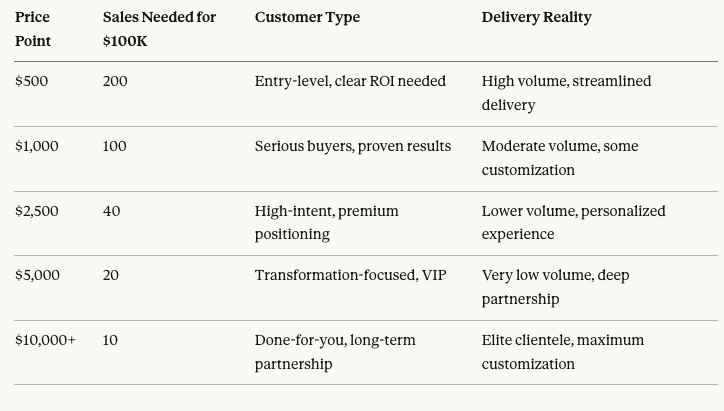
The pattern: The higher you go, the fewer customers you need—but each sale requires more trust, stronger positioning, and clearer transformation. You also need a website that reflects that premium positioning. If you're charging $5K but your site looks like a $500 Canva template, there's a disconnect.
Most six-figure brands have 2-3 offers at different price points:
- Entry offer ($50-500): Low-risk introduction to your world (mini-course, template, small workshop)
- Core offer ($1,000-5,000): Your signature program or service where most revenue comes from
- Premium offer ($5,000-25,000+): Done-for-you, VIP, or intensive for clients who want the fastest path
Stop Pricing by the Hour: The Transformation Pricing Formula
Hourly pricing caps your income and commoditizes your expertise. Instead, price for the transformation you deliver.
Ask yourself:
- What's this worth to my client in dollars? (Revenue gained, costs saved, time saved)
- What's the emotional value? (Peace of mind, confidence, status, freedom)
- What would they pay someone else to solve this problem?
Real example: If your branding service helps a coach book $10K in new clients within 3 months, your $3,000 package delivers a 3.3x ROI. That's not expensive, that's strategic.
If your website design helps a photographer save 10 hours per week by automating their inquiry process, that's 40 hours per month. If their time is worth $100/hour, that's $4,000 in monthly value. Your $5,000 package suddenly looks like a bargain.

Five Pricing Strategy Rules That Actually Work
1. Price for your positioning, not your years of experience If you're targeting premium clients, charge premium prices. Entry-level pricing attracts entry-level clients—even if you deliver premium results. In our experience at Showit, photographers who raised rates from $2K to $4K didn't lose half their bookings. They booked fewer clients but better ones who respected their process.
2. Test pricing early, but lean higher You can always lower prices (though it's painful and damages positioning), but raising them later means telling existing clients they got a discount you're no longer offering. Start where you want to grow into.
3. Bundle for perceived value A $3,000 package with 6 months of access, templates, and group calls feels more valuable than “$500/hour consulting” even if the math works out the same.
4. Never compete on price If you're the cheapest option, you'll attract price shoppers who become your most demanding, least loyal clients. Compete on transformation, process, or results never price.
5. Build in room to grow If you're already maxed out on capacity at your current prices, it's time to raise them. Pricing is how you control demand. Being booked solid at $2K means you're leaving money on the table, not that you've found the perfect price.
How to Package Your Offers So They Sell Themselves
Your offer isn't just what you deliver—it's how you package it, position it, and make the decision to buy feel like a no-brainer.
The Anatomy of a High-Converting Offer
1. Crystal-clear transformation Not “coaching”—what specific outcome do they get? Not “branding services”—what actually changes for them? Make it measurable: “Launch your first digital product in 90 days” beats “Learn how to create products.”
2. Delivery format that matches your audience
- Busy people want asynchronous (templates, recorded content, email support)
- Hands-on people want live calls and real-time feedback
- DIY people want step-by-step instructions they can follow alone
3. Well-defined scope
- What's included? What's not?
- How long does it last?
- What happens if they need more support?
Avoid open-ended services that lead to scope creep. “Unlimited revisions” sounds generous but becomes a nightmare. Define boundaries clearly.
4. Value stack that justifies the price Show everything they get:
- Core deliverable ($X value)
- Bonus templates ($X value)
- Group calls ($X value)
- Email support ($X value)
- Total value: $X → Your price: $Y
When the perceived value is 5-10x the price, buying feels easy. Your Showit sales page should showcase this value stack visually—not just list features in boring bullet points.
5. Remove friction from the buying process
- Payment plans for higher-ticket offers (3-6 monthly payments reduces sticker shock)
- Clear next steps (“Click here to book your strategy call”)
- Social proof (testimonials, case studies, actual results)
- Guarantees if appropriate (30-day money-back, satisfaction guarantee)
Offer design checklist:
✓ Is the transformation specific and measurable?
✓ Does the format match how your audience wants to learn/work?
✓ Is the scope clearly defined?
✓ Does the value feel like 5-10x the price?
✓ Have you removed unnecessary friction from buying?
Revenue Forecasting: Your Path to $100K (With Actual Math)
You can't hit six figures by accident. You need a plan—and the discipline to track whether you're actually on pace.
The Simple Revenue Formula
Revenue = (Number of Customers) × (Average Order Value) × (Purchase Frequency)
Example 1: 50 customers × $2,000 average purchase × 1 purchase per year = $100,000
Example 2: 200 customers × $500 average purchase × 1 purchase per year = $100,000
Both paths work. The question is: which model fits your capacity and business style?
Build Your Six-Figure Revenue Forecast
Step 1: Set your revenue goal
Let's say $100K for year one. (Adjust up or down based on your situation—some of you are going for $150K, others $75K to start.)
Step 2: Choose your pricing structure
- Core offer: $2,000
- Entry offer: $300
Step 3: Estimate conversion rates realistically
If 1,000 people see your offer and 5% buy, that's 50 customers.
Industry benchmarks we see consistently:
- Cold traffic (strangers from ads or search): 1-3% conversion
- Warm audience (email subscribers, social followers): 5-10% conversion
- Hot leads (people who've engaged multiple times, attended webinars, replied to emails): 20-30% conversion
Step 4: Calculate traffic needs
To get 50 customers at 5% conversion, you need 1,000 people to see your offer.
To get 1,000 people to your offer, you might need:
- 10,000 website visitors or email subscribers (if 10% click through to your sales page)
- Or 100 discovery calls (if 50% convert to buyers)
Step 5: Map it backward to daily/weekly actions
How do you get those leads?
Example:
- 10,000 website visitors = 200 visitors per week
- To get 200 weekly visitors, you need: SEO content, consistent social media, guest posts, or ads
- Break it down: 2-3 blog posts per week + daily social content + 1 guest post per month + optimized email popups (this is where BDOW! becomes essential for capturing visitors)
Reality check: Most people overestimate how many people will buy and underestimate how much marketing is required. Plan for a 2-5% conversion rate on cold traffic, 10-20% on warm audiences, and 30-50% on hot leads who've been in your world for a while.
Monthly Revenue Targets (Because $100K Feels Impossible Until You Break It Down)
Break your $100K goal into monthly targets. $8,333/month is a lot more manageable than a vague “six figures.”
Build in buffer: Life happens. Launches flop. Client projects get delayed. Plan to hit 80% of your revenue goal and you'll probably land closer to 100%.
Track What Actually Matters (Not Everything)
You can't manage what you don't measure. But you also don't need 17 dashboards. These are the tools and metrics that actually move the needle for six-figure brands:
Revenue tracking:
- QuickBooks Self-Employed or Wave (free accounting software)
- Stripe or PayPal for payment processing and automated reporting
- Google Sheets revenue tracker (simple, customizable, free)
Pipeline management:
- Dubsado or HoneyBook for client management and proposals
- Notion for tracking leads and follow-ups
- Simple spreadsheet for weekly check-ins (don't overcomplicate this)
Website + Email analytics:
- Google Analytics for traffic tracking
- BDOW! analytics for email capture rates and popup performance
The simplest system wins. If you won't use it weekly, it's too complicated.
Weekly check-in (5 minutes):
- Revenue this week
- Pipeline (how many leads or active conversations)
- Are you on track for monthly goal? If not, what needs to change?
Monthly review (30 minutes):
- Total revenue vs. goal
- Which offers sold? Which didn't?
- Where did customers come from?
- What's working? What needs to change?
Quarterly deep dive (2 hours):
- Full financial review
- Adjust pricing or offers if needed based on what's selling
- Plan marketing strategy for next quarter
The brands that hit six figures aren't the ones with the best products. They're the ones who track their numbers every week and adjust strategy based on what's actually working.

Seven Pricing Mistakes That Keep Creative Entrepreneurs Stuck Under Six Figures
Mistake #1: Too many offers
If you're selling 10 different things, you're confusing your audience and diluting your marketing. Start with 1-2 core offers. Add more only when those are consistently selling. We see this constantly—creative entrepreneurs with beautiful websites offering seven different packages. Simplify to scale.
Mistake #2: Chronic underpricing
Charging too little doesn't just hurt your margins—it attracts the wrong customers. Low prices signal low value. Price for the transformation, not your time. If your service saves a client 20 hours per month, price accordingly.
Mistake #3: No clear path to revenue
“I'll figure out monetization later” is a recipe for a hobby, not a business. Know how you'll make money before you spend 6 months building an audience. Revenue first, audience second.
Mistake #4: Ignoring customer retention
Chasing new customers while ignoring existing ones is expensive and exhausting. A repeat customer is worth 5-10x a new one. Build offers that encourage repeat purchases or ongoing relationships.
Mistake #5: Scaling too fast
Adding offers, hiring a team, or running ads before you've proven product-market fit is a fast way to burn cash. Validate first with scrappy methods, scale second with systems.
Mistake #6: Apologizing for your prices
If you don't believe your pricing is fair, your potential clients won't either. Own your rates. If someone says you're too expensive, that's valuable information—they're not your ideal client.
Mistake #7: No payment plans for high-ticket offers
A $5,000 package feels insurmountable as one payment. Break it into $500/month for 10 months or $1,700 for 3 months, and suddenly it's accessible without devaluing your work.

Frequently Asked Questions About Six-Figure Pricing
How do I know if I'm undercharging?
If you're booked solid, turning away clients, and still not hitting your income goals, you're undercharging. If clients say yes immediately without asking questions, you're probably leaving money on the table. The right price creates just enough healthy friction.
Should I raise prices for existing clients?
Honor existing contracts, but raise prices for new clients immediately. You can transition existing clients at renewal: “My rates are increasing to $X on 2026. Your current rate is locked in through [end of contract], then we'll move to the new pricing.”
What if I raise my prices and no one buys?
This is a positioning problem, not always a pricing problem. Make sure your website, messaging, and offer clearly communicate the transformation you provide. Sometimes you need to raise prices AND improve how you talk about value.
How many clients do I actually need to make six figures?
It depends entirely on your pricing. At $5,000 per client, you need 20. At $2,000, you need 50. Use the pricing framework table earlier in this article to find your path.
Your Business Model Action Plan: What to Do Next
You've just walked through the essential elements of building a six-figure business model. Here's what you should have now:
✓ Chosen your business model (service, product, or hybrid)
✓ Strategic pricing for your core offers that reflects transformation, not just time
✓ Well-designed offers with clear transformation and strong value stack
✓ Revenue forecast showing your realistic path to $100K
✓ Monthly targets broken down into manageable, trackable goals
✓ Weekly tracking system to stay on pace
What Comes Next: Marketing Your Six-Figure Business
Your business model is set. Your pricing is strategic. Now it's time to get people to actually see it.
In Part 3 of this series, we'll cover:
- Marketing strategy that actually works in 2026 (not just “post more on Instagram”)
- How to use SEO, email, and content to build a consistent pipeline
- Where AI fits into your content strategy without making you sound like a robot
- Building community that drives revenue, not just engagement
The truth: You can have the best pricing strategy in the world, but if no one knows you exist, it doesn't matter. Part 3 shows you how to build a marketing system that brings the right clients to your door—without burning out on social media.
Final Word
Building a six-figure business isn't about working harder. It's about working smarter—with a business model that makes the math actually work, pricing that reflects the value you create, and a system for tracking whether you're on pace.
You've got the framework. Now go build the business.

Sarah has been part of the Showit team for nearly four years, where she works as a copywriter crafting content that educates, encourages, and celebrates the creative entrepreneurs who make up the Showit community. When she's not writing, you'll find her with a book in hand (usually something about leadership or personal growth), cheering on Arizona sports teams, or connecting with people over a really good cup of coffee because, let's be honest, there's always a cup nearby. Sarah believes in the power of stories, the importance of showing up authentically, and that every entrepreneur deserves to be celebrated for the brave work they're doing.