Load Newsreader Bold Font
Want a competitive advantage in 2026? Here it is. It’s blogging, if the title didn’t already give it away.
Not the most fun answer, but while everyone else has been busy chasing algorithms and trending audio, the creators who never stopped blogging are probably pretty happy right now.
Why? Because, they’re getting found by the right people without having to post every day to stay visible.
Blogs can keep showing up in search results for years, answering the same question your ideal client is Googling. And unlike your social following, your blog lives on your website, which means you own it.
This guide will help you start a blog that show up in search to bring in the kind of clients you want.
By the end, you’ll have a clear picture of blogging and how to build one that works for your business, including how to show up in AI driven search tools like Google’s AI Overviews, ChatGPT, and Perplexity, which is where a lot of discovery is happening these days.
TL;DR How a Blog Can Help Your Business
Blogging is one of the most underused tools in a creative entrepreneur’s business right now – and that’s exactly what makes it such a good opportunity.
Here’s the short version:
- Your blog is content you actually own. Social media can disappear overnight. Your blog lives on your website and works for you long after you’ve posted it.
- The data is in favor of blogging. According to Neil Patel and NP Digital, websites with a blog generate 75% more organic search traffic and nearly 50% more backlinks than those without one.
- Specificity beats volume. You won’t out-publish AI generated content, but you can out-specific it. Writing for a specific person with a specific problem is how you actually get found.
- Your real experience is your biggest advantage. The content that ranks and gets recommended in 2026 is built on genuine human expertise, something no AI can replicate.
- A blog works across the full funnel. It extends your portfolio, attracts warmer leads, builds authority, and creates a clear path from reader to client.
- It’s a long game. Most blogs don’t see meaningful traffic for three to six months. The ones that win are the ones that kept going.
Why a Blog Does Something Social Media Simply Can’t
Neil Patel and his agency, NP Digital, found that websites with a blog generate 75% more organic search traffic, nearly 50% more backlinks, and a meaningfully higher conversion rate than sites without one.
That’s a significant difference.
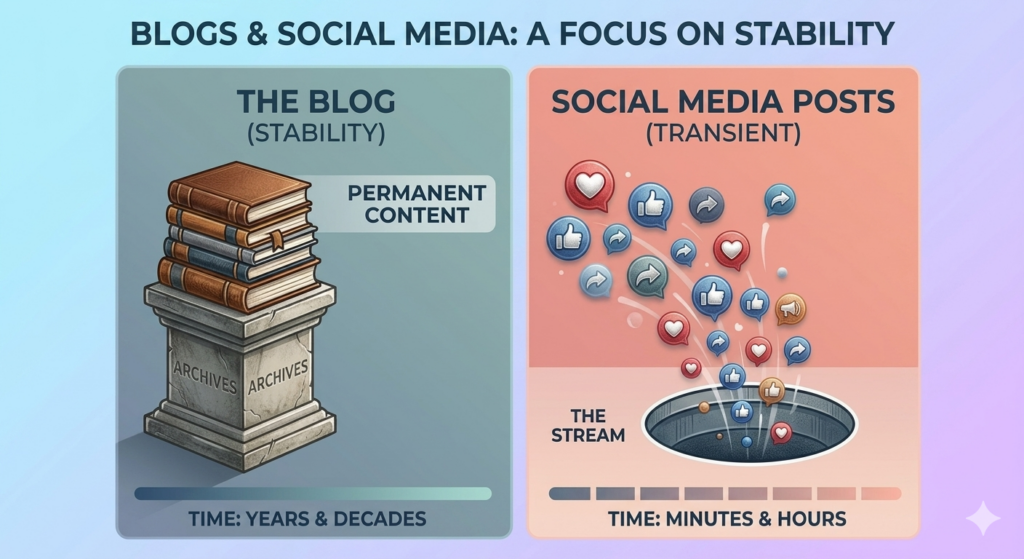
But the reason comes down to how a blog post works differently than a social post.
All the work you put into your social content has about a 24-48 hour window before the algorithm moves on. A blog continues to bring you new traffic for years as long as your posts answer the right questions for your ideal clients.
Patel also found that with roughly 4.6 billion pieces of content published every day, the content that actually cuts through isn’t the most frequent or the most polished, it’s the content built on real human experience and a specific point of view. Which, as a creative entrepreneur, is exactly what you have.
That matters more right now than it ever has. Andy Crestodina of Orbit Media, whose annual blogger research is one of the most cited in the industry, has noted that people are increasingly turning to AI tools first, asking things like “who’s the best brand photographer in my area?” or “what should I look for in a web designer?” before they ever visit a website.
The brands that get recommended in those moments are the ones with clear, credible, specific content behind them. A blog is a big part of how you build that.
For creative businesses specifically, a blog does three things at once.
- It extends your portfolio: your work gets to live in context rather than just in a grid
- It attracts warmer leads: people who find you through search are already looking for what you do
- it builds authority: the kind that search engines and AI tools use when deciding whose work to surface and recommend
Social media shows people your highlight reel. A blog shows them why you’re the right choice.

How to Start a Blog Step 1: Start With What Makes You Unique
Most blogging guides will tell you to start with keyword research and that’s not bad advice.
Understanding what people are actually searching for is a useful starting point. You want to know there’s an audience for what you’re writing about before you invest the time.
But here’s where people go wrong, they find a high-volume keyword and try to write the definitive post on a broad topic to win traffic. The problem is those topics are crowded, and they’re increasingly dominated by AI-generated content that people can read without ever clicking to a website.
The way you actually win in 2026 isn’t by chasing the biggest keywords. It’s by writing well rounded content that speaks to a specific person with a specific problem.
Think about it this way, before you write anything, ask yourself three questions.
- Is this something people are actually searching for?
- Is this something I know well enough to write about with real depth?
- Is this something I can bring a perspective to that a generic article/AI couldn’t?
When the answer to all three is yes, you’re in a good spot.
The goal is to find topics that sit at the intersection of what people are searching for and what you genuinely know how to talk about.
Here’s what that looks like in practice:
| Instead of… | Try… |
|---|---|
| Wedding photography | Best lenses for wedding photography |
| Lead magnet | Lead magnet examples for creative entrepreneurs |
| How to build a website | How to build a website for a nonprofit organization |
| How to start a small business | How to start a small office cleaning business |
| Photography tips | Film photography for sustainable brands |
| Design advice | Brand design for independent wellness coaches |
Just for fun, let’s check out the “How to start a small business” example.
If we use a tool like Semrush to help us, we can see that it would be pretty difficult to rank for that keyword.
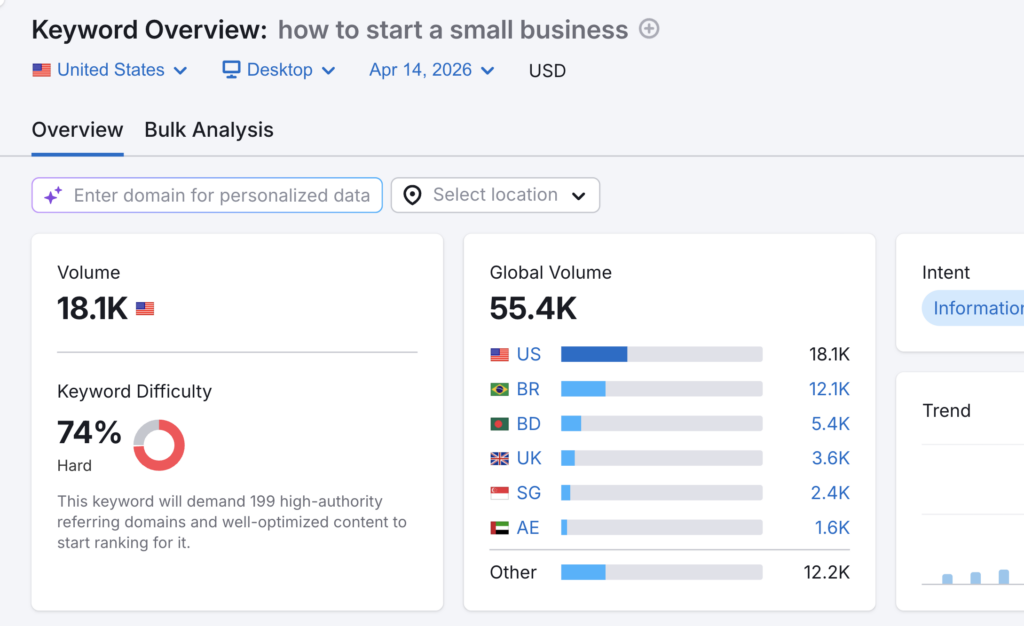
Now, let’s see what “How to start a small office cleaning business” looks like.
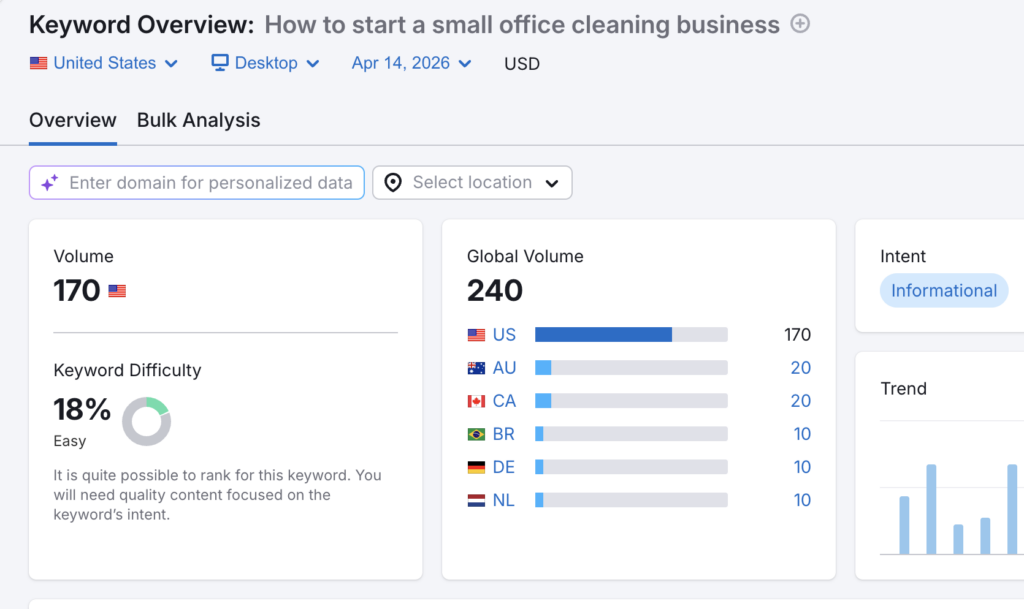
This is something you can explore yourself in a tool like Semrush or even Google’s free keyword planner.
Look for the sweet spot, a topic with enough search volume to be worth writing about, but specific enough that you have a real shot at ranking for it.
And keep in mind, this is a marathon, not a sprint. Just because a keyword has low search volume today, it could grow in popularity over time. So don’t count out a topic just because the numbers aren’t huge right now.
Step 2: Choosing the Right Platform to Start Your Blog
This doesn’t have to be complicated, it mostly comes down to what you value most.
WordPress is the SEO gold standard for good reason. It’s powerful, flexible, and search engines know it well. If you have some technical comfort or a developer you trust, it’s a great foundation to build on.
Squarespace is worth a look if you want to get up and running without a steep learning curve. The templates are polished, the interface is intuitive, and for creatives who want simplicity without sacrificing style, it delivers.
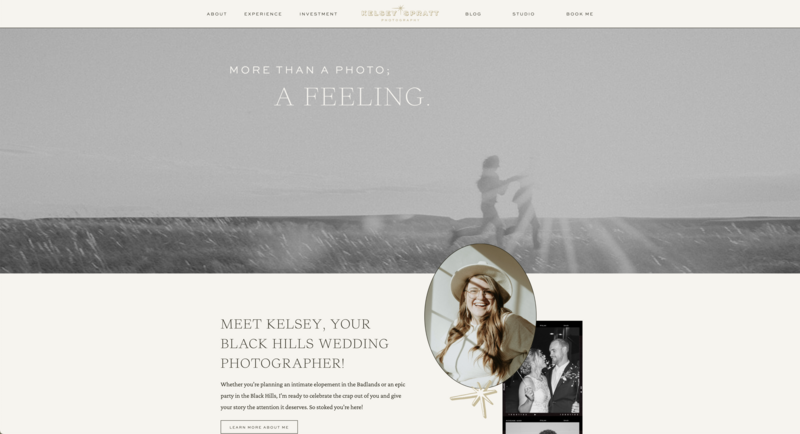
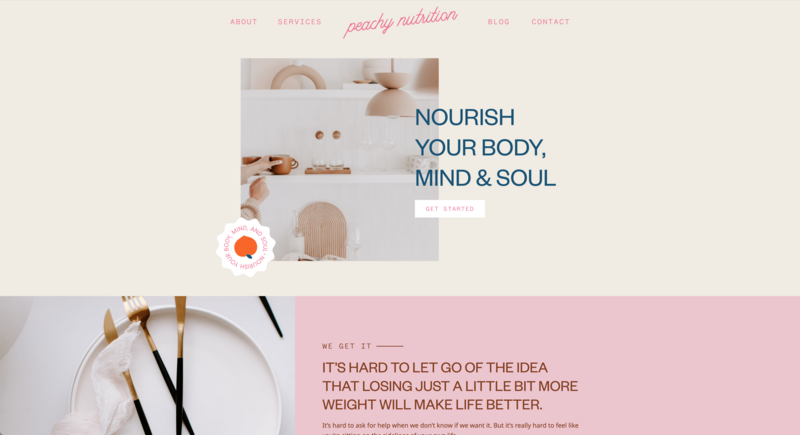
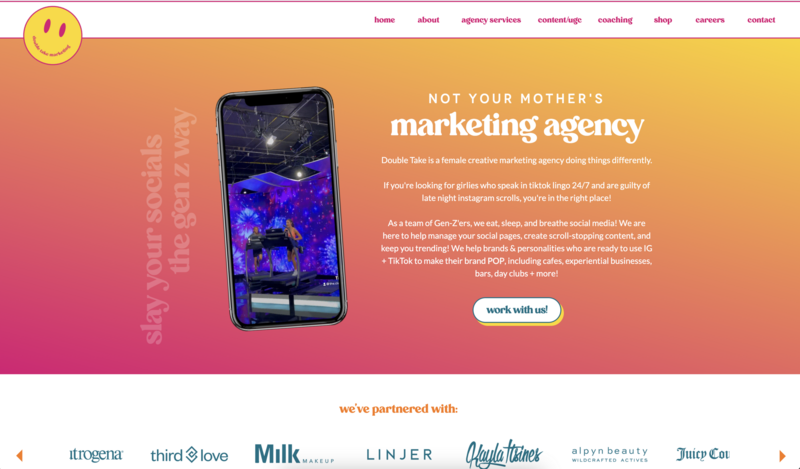
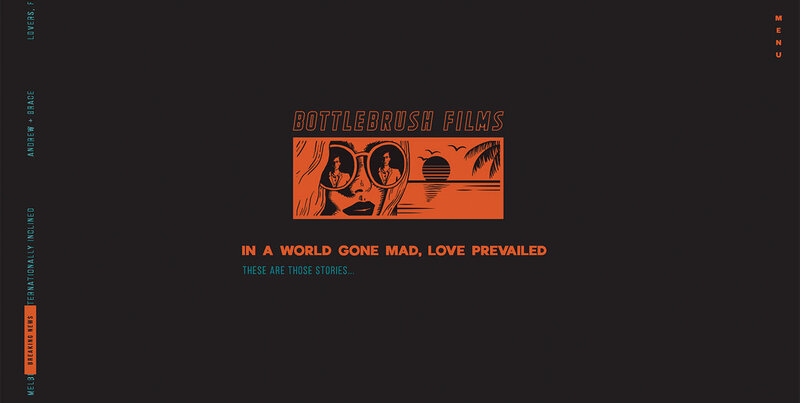
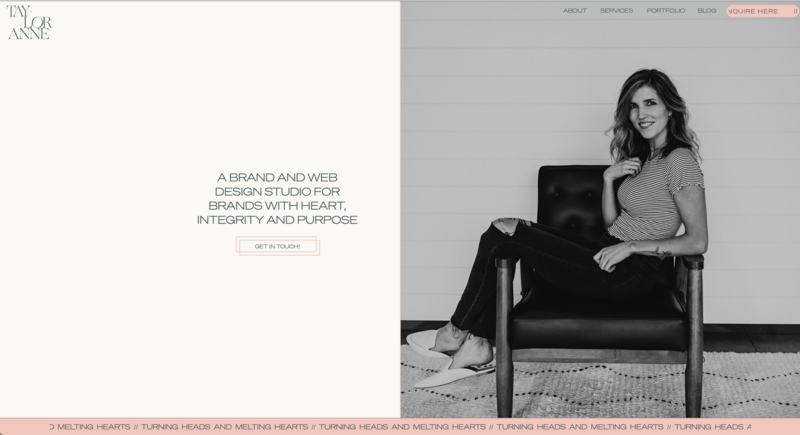
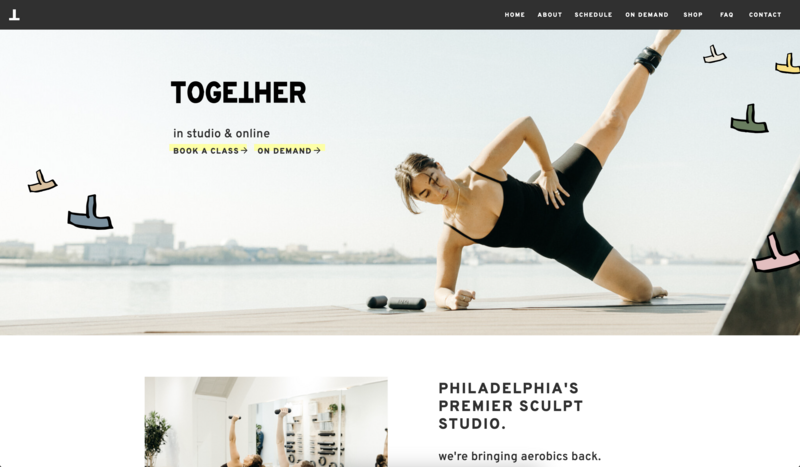
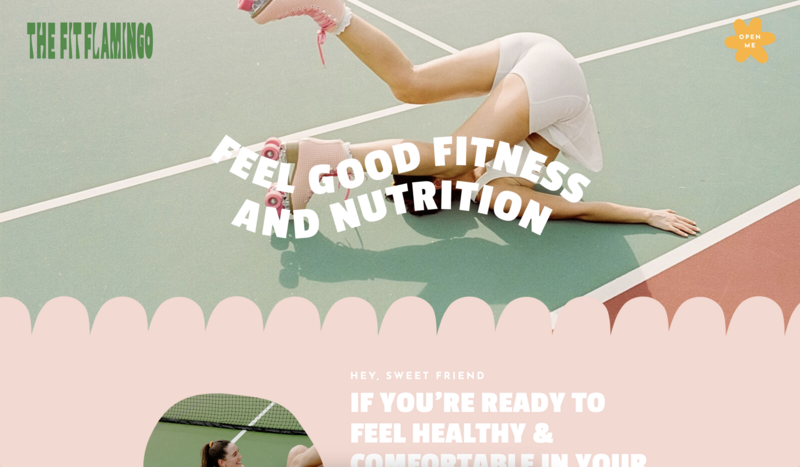
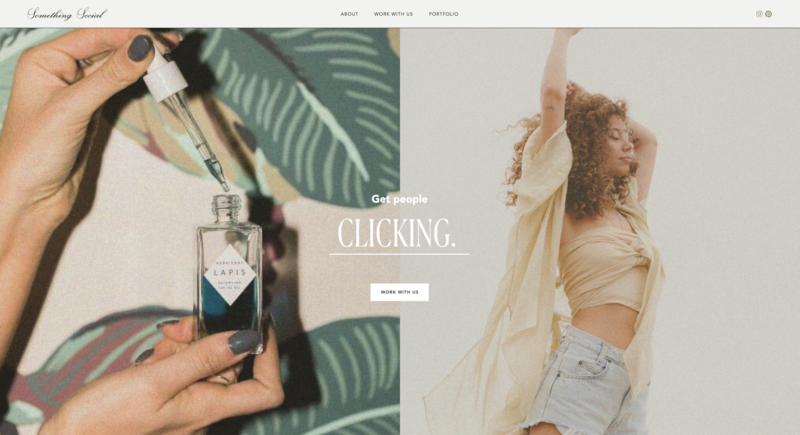
Showit is worth a close look if design is non-negotiable for you. Most platforms make you choose between a site that looks the way you want and a site that performs well in search, but Showit is one of the few that genuinely doesn’t.
You get a completely freeform drag-and-drop canvas that lets your blog look exactly like your brand, powered under the hood by WordPress. So you’re getting the same SEO infrastructure that professionals have relied on for years but with a great design interface too.
Whatever you choose, page speed matters. Google uses it as a ranking signal, and slow-loading pages don’t just frustrate visitors, they hurt your visibility.
A few quick wins for creative sites specifically:
- Use WebP format for all images. Same visual quality, significantly smaller file size.
- Compress images before uploading. Your portfolio shots are gorgeous; a 6MB file is not.
- Choose a theme or layout that’s been optimized for performance, not just looks.
Step 3: Design Your Blog for the Reader First
SEO used to mean placing keywords in the right spots. In 2026, it means creating an experience that both people and AI systems find easy to navigate.
Start With Your Headings
Every H2 and H3 is an opportunity, instead of a section header like “My Process,” try something like “What Does the Brand Photography Process Actually Look Like?”
That question format mirrors how people search and how they talk to AI tools. That means your content is more likely to show up in Featured Snippets and AI-generated answers.
Prioritize Visual Consistency
Visual consistency matters more than most people realize. A cohesive look with consistent colors, typography, and image style doesn’t just make your blog feel professional.
It builds the kind of brand recognition that signals credibility to both readers and the AI systems increasingly being trained on web content.
The Gallery-First Layout
One of the most underused approaches for creative bloggers is integrating your actual work directly into your posts rather than keeping your portfolio completely separate.
A post about your process becomes significantly more compelling when it’s built around real images from a real project. Readers see your expertise and your aesthetic at the same time and that combination is a hedge agains AI.
Step 4: Write Blog Content Around Real Experiences
Google’s E-E-A-T framework, that’s, Experience, Expertise, Authoritativeness, and Trustworthiness is the clearest signal of what both search engines and AI tools are looking for right now.
And as a creative entrepreneur, you’re already sitting on exactly this kind of content. You’re just not publishing it yet.
Behind-The-Scenes Content
Behind-the-scenes content is one of your strongest assets. A post that walks through your actual creative process, what you tried, what didn’t work, what you’d do differently is the kind of first-hand experience that AI-generated content simply can’t replicate. Generic tips can come from anywhere. Your real experience can’t.
The Answer-First Method
This is a simple structural shift that pays off. Start every post with a clear, direct answer to the question your title poses, ideally in the first 50 words.
AI tools pull opening summaries when generating responses. If your post buries the answer deep in the body, it’s much less likely to get cited. Lead with the answer, then earn the depth.
Three Content Pillars That Work for Creative Entrepreneurs:
- Tutorials and How-To posts: Establish your expertise. Show people how to do something you know how to do.
- Case Studies and Client Stories: Build trust. Real results with real people are the most convincing content you can publish.
- Inspiration and Moodboards: Establish your aesthetic. These posts attract your ideal clients by showing them what your taste looks like—and by extension, what working with you looks like.
A good content calendar rotates across all three. Tutorials bring in readers. Case studies help convert them.
Step 5: Optimize to Show Up in AI Search Results
If you’re not thinking about how AI search tools find and use your content, this is the time to start.
Tools like Perplexity, ChatGPT Search, and Google’s AI Overviews are becoming the largest place your ideal clients go first when they’re looking for someone like you.
Here’s how to show up in those results.
Schema markup
This is the language search engines use to understand what type of content they’re looking at. A plugin like Yoast SEO or RankMath lets you tag your posts as “HowTo,” “FAQ,” “Article,” and other formats without touching any code.
Think of it as labeling your content so AI systems can file it correctly, which makes it much more likely to appear in structured responses.
Entity linking
This is about connecting your content to recognized authorities in your space.
When you reference a specific tool (say, Honeybook or Lightroom), a well-known creative, or a professional association, you’re helping AI systems place your content within a known ecosystem.
Your blog stops being an isolated page and starts being part of a network of recognized knowledge. That’s how AI models learn to trust your content.
Alt text written for context, not just compliance
Instead of labeling an image “photo of vase,” write “minimalist white ceramic vase on a sunlit oak table, handmade by small-batch ceramicist.”
You’re describing the vibe, the context, the maker; information that’s useful to both visually impaired readers and AI image-parsing systems.
The Answer-First structure
Remember this from step 4, this doubles as your most powerful GEO tool.
AI models summarize. They pull the most citable, cleanest answer they can find. If your post buries the answer in paragraph six, you won’t get cited. If you lead with it, you will.
Step 6: Turning Blog Readers Into Clients
A blog without a clear next step for readers is a well-designed dead end. Here’s how to build a path from “someone found your post” to “someone hired you” without making every post feel like a sales pitch.
The basic flow looks like this: a reader finds your post through search, reads something genuinely useful, sees that you clearly know what you’re talking about, and then you offer them something valuable in exchange for their email.
Now they’re on your list, and you can build that relationship over time until they’re ready to hire you or buy from you. This part requires consistency and a little patience, it’s where a lot of creative entrepreneurs give up. But it’s also where the real payoff is.
Offer a Lead Magnet
Lead magnets are key and for creative entrepreneurs, the best ones feel like a natural extension of the post the reader just finished.
A style guide, a mini pricing template, a curated resource list, a behind-the-scenes workflow doc.
Something that delivers real value and leaves them wanting more. Tools like BDOW! can help you serve the right offer to the right reader at the right moment, without it feeling like an interruption to the experience you’ve built.
Blog Monetization
Don’t just stop at Google display ads. For most creative entrepreneurs, ads generate pennies while your real value is elsewhere.
Focus on:
- High-ticket services: Every post should have a soft path back to your services page. Not a hard sell just a clear next step for readers who want more than the blog post.
- Digital products: Templates, presets, guides, courses. Things you make once and sell repeatedly.
- Affiliate links: Recommend the tools you actually use. If someone buys because of your recommendation, you earn a commission. Only do this for things you’d recommend anyway your audience can tell the difference.
Step 7: Promote Your Blog (Without Starting From Scratch)
Publishing and waiting is the most common mistake new bloggers make. A better approach is building a simple promotion loop that extends the life of every post you create.
Pinterest is your secret weapon
It’s genuinely one of the most underrated traffic sources for creative entrepreneurs. Unlike social platforms where content has a short shelf life, a well-designed pin linked to a strong blog post can keep driving traffic months or even years later.
If you’re a visual creative and you’re not using Pinterest to promote your blog, it’s worth taking seriously.
Repurposing: (your other secret weapon)
A single long-form blog post can become:
- 5 short-form video scripts (Reels, TikToks)
- 3 LinkedIn or Instagram carousels
- 1 email newsletter
- Multiple Pinterest pins
You’re not creating new content, you’re redistributing the thinking you already did. The blog post is the source. Everything else is derivative, and that’s a feature, not a bug
Community commenting
This is an underused backlink strategy that actually works. Leaving thoughtful, substantive comments on other respected blogs in your industry builds relationships, drives referral traffic, and creates a natural backlink profile that search engines recognize as authentic.
This isn’t blog-spam commenting (“Great post!”). It’s genuine engagement that also happens to signal authority.
Internal linking
The quiet compounding engine of your blog. Every new post should link to at least one relevant existing post or service page.
This passes SEO authority around your site, keeps readers on longer, and creates a web of related content that makes your expertise feel comprehensive, to both readers and search engines.

Common Blogging Mistakes to Avoid
Even with the best intentions, these are the pitfalls that keep creative blogs from gaining traction.
Starting too broad
“Tips for photographers” is not a niche. The more specific your focus, the faster you’ll build authority, and the more clearly AI systems can categorize and recommend your content.
Prioritizing aesthetics over performance
A beautiful blog that loads in 8 seconds is a blog people leave before they read it. Speed is a ranking factor and a user experience factor. Both matter.
Writing for yourself instead of for search intent
Your blog needs to answer questions your ideal clients are actually asking, not just topics you find interesting. These can overlap, but you have to be intentional about it.
Publishing without a conversion path
If there’s no email opt-in, no CTA, no link to your services, a reader finishes your post and… leaves. You got the traffic and gave away the value with nothing in return. Every post needs a logical next step.
Quitting after 3 posts because “it’s not working“
SEO takes time. Most blogs don’t see meaningful organic traffic for 3–6 months. This is a long game. The blogs that win are the ones that kept publishing while everyone else stopped.

How to Start Blogging FAQs
How long does it take for a blog to show up in Google search results?
Most new posts get indexed within a few days to a few weeks. Ranking competitively for a topic usually takes three to six months of consistent publishing. A specific niche and genuinely helpful content both speed that up.
Do I need a blog if I already have a strong Instagram following?
Yes, because you don’t own your Instagram following. A blog is the only platform where you fully control your content, your audience relationship, and your visibility. Social medHia should feed your blog, not replace it.
What’s the best blogging platform for photographers and designers?
For visual creatives who want design freedom without giving up SEO performance, Showit is worth a serious look. It combines a drag-and-drop canvas with a WordPress-powered blog, so you get a site that looks like your work and actually shows up in search.
How many posts do I need before my blog starts driving traffic?
Consistency matters more than volume. One well-researched, well-structured post a week will outperform a burst of thin posts followed by silence. Aim for depth over frequency, especially early on.
Can I use AI to write my blog posts?
AI is a useful tool for research, outlining, and editing. But as Neil Patel has pointed out, the content that ranks and gets recommended is built on real human experience and a genuine point of view, things AI can help you organize, but can’t create for you. Use it to work faster, not to replace your voice.
The Gong Game
A social post disappears in 48 hours. A blog post can keep working for years.
Every piece of content you publish on your blog is something that can be found, shared, cited, and discovered long after you’ve moved on to the next project. It’s one of the few things in your business that genuinely compounds over time getting more valuable the longer you stick with it.
That’s exactly how a well-built blog should work and it’s why creative entrepreneurs who commit to it tend to look back a year or two later and say it was one of the better decisions they made for their business.
You’ve got the strategy. The next step is to just start blogging.
And if you’re still figuring out where to build, start your free Showit trial and see what a blog that actually looks like your brand can feel like.

Sarah has been part of the Showit team for nearly four years, where she works as a copywriter crafting content that educates, encourages, and celebrates the creative entrepreneurs who make up the Showit community. When she's not writing, you'll find her with a book in hand (usually something about leadership or personal growth), cheering on Arizona sports teams, or connecting with people over a really good cup of coffee because, let's be honest, there's always a cup nearby. Sarah believes in the power of stories, the importance of showing up authentically, and that every entrepreneur deserves to be celebrated for the brave work they're doing.